
NEMA 14-50 vs Hardwired EV Charger: Which Wins?
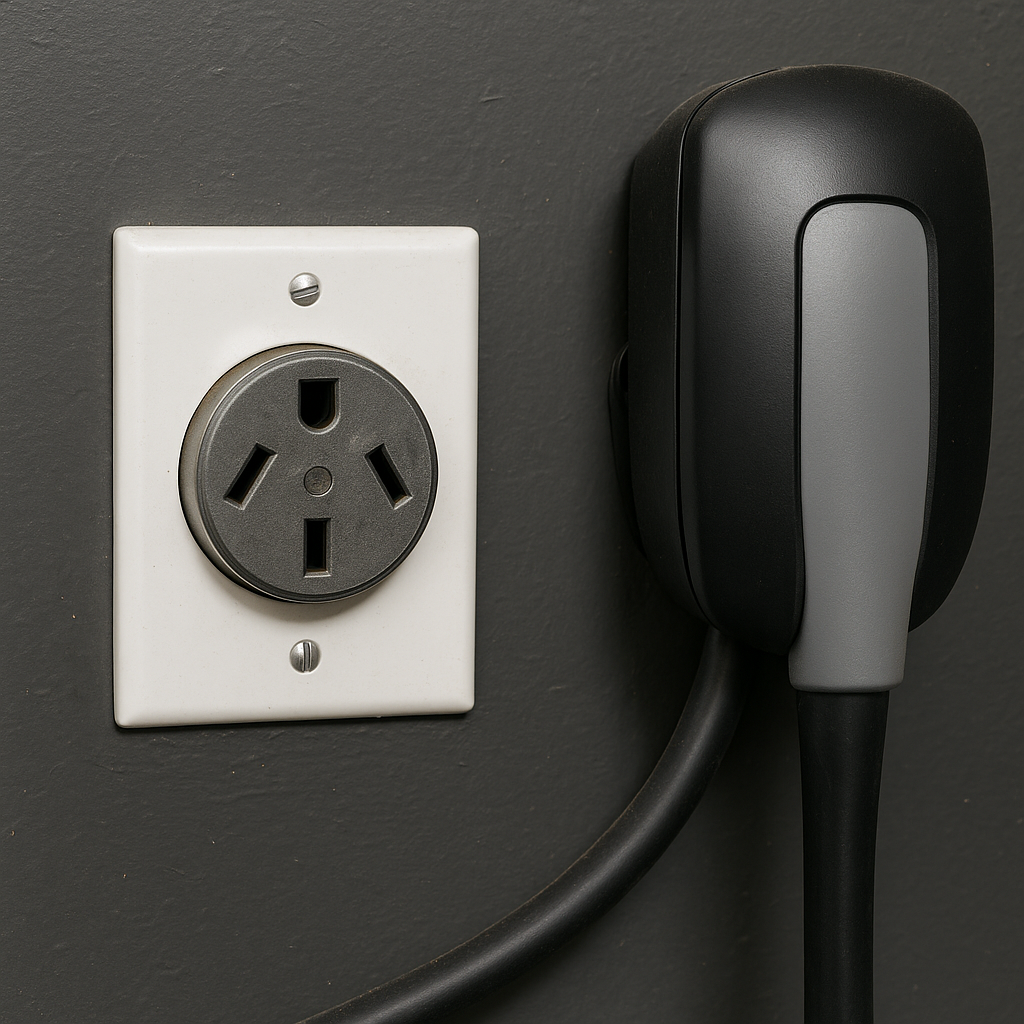
Quick Answer: A NEMA 14-50 outlet gives you a plug-in connection: flexible, easy to swap chargers, and simple to take with you when you move. A hardwired charger is fixed to the circuit without a plug, which suits outdoor and wet locations better and can support higher amperage on units that support it. Both require a licensed electrician and a dedicated 240-volt circuit.
Once you decide to stop relying on public chargers and put a Level 2 charger in your own garage, one question decides the rest of the job: does the charger plug into an outlet, or does it wire straight into the circuit? Both approaches feed the car the same 240 volts, and both start with the same foundation, a dedicated circuit run from your panel. The difference is the last few inches, where the charger meets the wiring. That small difference changes portability, the top charging speed you can reach, how the setup holds up outdoors, and how ground-fault protection is handled.
How Each Connection Actually Works
A NEMA 14-50 is a 240-volt receptacle, the same style you would see behind an electric range or at an RV pedestal. Your electrician runs a dedicated circuit to that spot, mounts the outlet, and you plug the charger's cord into it. The charger itself hangs on the nearby wall, drawing power from the plug. Nothing about the charger is permanently attached to the house, which is the whole appeal of this route.
A hardwired charger skips the receptacle entirely. The circuit's conductors land directly on terminals inside the charging unit, and the unit is fastened to the wall as a permanent fixture. There is no plug and no outlet in the path. Electrically, it is one continuous connection from the breaker to the charger, with nothing in the middle that can be unplugged, wiggle loose, or work its way out over years of heat cycling.
That single design choice, plug versus no plug, is what everything else follows from. A plug is a connection point you can open and close at will, and that convenience also carries every amp the charger pulls. A hardwired terminal has no such tradeoff because it never opens.
The Continuous Load Rule Behind Both Setups
EV charging behaves differently from most things you plug in at home. A microwave or a hair dryer runs at full power for a few minutes. A car charger can draw its full current for hours without interruption, and electrical rules treat that sustained draw as a continuous load. Because of that, the circuit and the breaker feeding an EV charger are sized above the charger's actual draw, with a margin built in on top of the number the charger pulls.
Picture a highway lane rated for steady traffic rather than a brief rush. You do not run it at bumper-to-bumper capacity all day and expect it to hold up. You leave headroom. The same logic applies to sizing an EV circuit: the wire gauge and breaker are chosen so the charger's continuous draw sits comfortably below the circuit's limit, not right at the edge. This is why the breaker rating is always larger than the charger's amp figure, and it applies whether the charger plugs in or is hardwired.
This matters equally for both setups, but it interacts with the plug question. A 14-50 receptacle and the cord that plugs into it become part of that continuous-load path, so the outlet has to be a quality unit rated for the job and installed on a properly sized breaker. A cheap receptacle that gets warm under a steady load is exactly the failure a good installation is built to avoid.
Portability and Swapping Units
This is where the NEMA 14-50 earns its reputation. Because the charger connects with a plug, you are not married to it. If a newer charger comes out, or your current one fails, you unplug the old one and plug in the new one. When you sell the house and move, the charger comes with you, and the outlet stays behind for the next owner, who can bring their own unit. The receptacle is generic; the charger is yours.
A hardwired unit gives that flexibility up in exchange for permanence. Swapping a hardwired charger, or removing it to take along, means disconnecting wiring, which is an electrician's job rather than a five-minute unplug. If you value the freedom to change equipment or you rent and expect to move, the outlet route keeps your options open in a way hardwiring does not.
Outdoor, Garage, and Wet Locations
Where the charger lives changes the calculus. A hardwired connection has no exposed plug and receptacle, so there is no metal contact surface exposed to humid or wet air, waiting to corrode or loosen. For an exterior wall, a carport, or a detached garage that sees moisture, that sealed, permanent connection is a real advantage and is often the cleaner answer.
A plug-in 14-50 can absolutely live outdoors, too, but it must be done right. The receptacle needs a proper weatherproof enclosure rated for the location, keeping water off the contacts while the cord is plugged in. Done that way, it works. The point is not that a plug-in setup fails outside; it is that hardwiring removes the exposed connection that outdoor conditions attack, so it starts a step ahead in a wet spot.
Charging Speed and the Unit's Own Spec
Here is a detail that surprises people: with some chargers, the connection method caps how fast you can charge. A number of units are rated at one amperage when plugged into a 14-50 receptacle and at a higher amperage only when hardwired. The manufacturer sets that limit in the unit's own specification, not the electrician. If you own or are buying one of those chargers and want its full charging speed, hardwiring is not optional; it is what the spec requires to reach the top rate.
Not every charger works this way. Plenty deliver the same output either way. So the honest answer is to read the spec sheet for the exact unit you plan to install. If its maximum output is only available hardwired, and reaching that output matters to you, that one fact can settle the decision on its own.
Ground-Fault Protection Differs
Both setups protect against ground faults, but they get there by different paths. Many hardwired chargers include ground-fault protection built into the unit itself, so the protection lives in the charger. A plug-in setup on a 14-50 may instead call for that protection at the breaker, since the receptacle is a general-purpose outlet rather than a charging device.
The practical result is that the right approach depends on the specific equipment in front of you. Your electrician looks at what the charger provides on its own and fills the gap accordingly, protection at the breaker for a plug-in outlet, or reliance on the charger's built-in protection when it has it. It is not a case of one method being safe and the other not; it is two correct ways of covering the same requirement, matched to the hardware.
Side-by-Side Comparison
| Factor | NEMA 14-50 Outlet | Hardwired Charger |
|---|---|---|
| Portability | High, unplug and take it | Low, wired in place |
| Outdoor and wet locations | Works in a rated enclosure | Often preferred, no exposed plug |
| Maximum amperage | May be capped by unit spec | Can reach unit's top rating |
| Receptacle in the path | Yes, a plug and outlet | No, direct connection |
| Ground-fault protection | Often at the breaker | Often built into the charger |
Why This Is Not a DIY Project
Every path here involves a 240-volt circuit and work at or near your electrical panel, which is not homeowner territory. The conductors carry enough energy to injure or start a fire if they are undersized, loosely terminated, or protected by the wrong breaker. Sizing the circuit for a continuous load, selecting a receptacle that can take that load, weatherproofing an outdoor install, and matching ground-fault protection to the equipment are all judgment calls a licensed electrician makes routinely, and a DIY guess gets wrong. Both the outlet and the hardwired route are licensed-electrician installs on a dedicated 240-volt circuit, full stop.
Frequently Asked Questions
Yes, and the outlet you leave behind keeps its value. The 14-50 receptacle stays as a resale feature, the next owner can plug their own cordset into, so nothing you installed goes to waste. That same receptacle also doubles as an RV or welder outlet when no car is charging, which is handy in a garage or shop. A hardwired unit gives up all of that, since removing it means an electrician has to disconnect the wiring rather than a quick unplug.
Often, yes, and the reason is what each setup demands outdoors. A plug-in unit used outside needs a weatherproof in-use cover, the hinged "bubble" type that closes over the cord while it is plugged in, sitting on a rated enclosure, typically NEMA 3R or 4. A hardwired unit's sealed connection has no plug or receptacle exposed to the weather, so it avoids that exposure entirely and skips the extra enclosure hardware. In a wet or salty spot, that sealed connection simply starts a step ahead.
Sometimes, and a concrete case makes it clear. Some 48-amp chargers can only run at 40 amps on a 14-50 plug and reach their full 48 amps only when hardwired. The reason is that a plug connection is rated at 40 amps continuous, so the unit throttles itself to stay within the receptacle’s safe capacity. Not every charger works this way, and plenty deliver the same output either route, so read the spec sheet for the exact model you own before deciding.
Because EV charging is a continuous load, the circuit and breaker are sized above the charger's draw rather than exactly matching it, with a common rule adding a margin on top. That margin is why a charger rated at 40 amps needs a circuit larger than 40 amps, not one that matches it exactly, giving the wiring headroom during hours of steady charging.
Yes. A hardwired charger usually has built-in ground-fault protection, a device called a CCID inside the unit, so it may not need a GFCI breaker feeding it. A plug-in 14-50 setup often needs GFCI protection at the breaker instead, since the outlet is a general-purpose receptacle rather than for charging equipment. One side effect worth knowing: that breaker-level GFCI can occasionally cause nuisance trips, so your electrician matches the protection to what the specific charger already provides.
Not safely for regular charging. Those circuits are shared with an appliance and sized for intermittent use, not for the hours-long continuous draw an EV charger produces. An EV charger needs its own dedicated 240-volt circuit rather than sharing an appliance outlet, so borrowing the dryer or range receptacle is not a substitute for a purpose-built circuit.
Book a licensed electrician for your EV charger install — get the right circuit, connection, and protection matched to your unit. Castles Electrical serves Virginia Beach, Chesapeake, and Norfolk. Call (757) 765-8222.