
Federal Pacific and Zinsco Panels: The Hidden Fire Risk
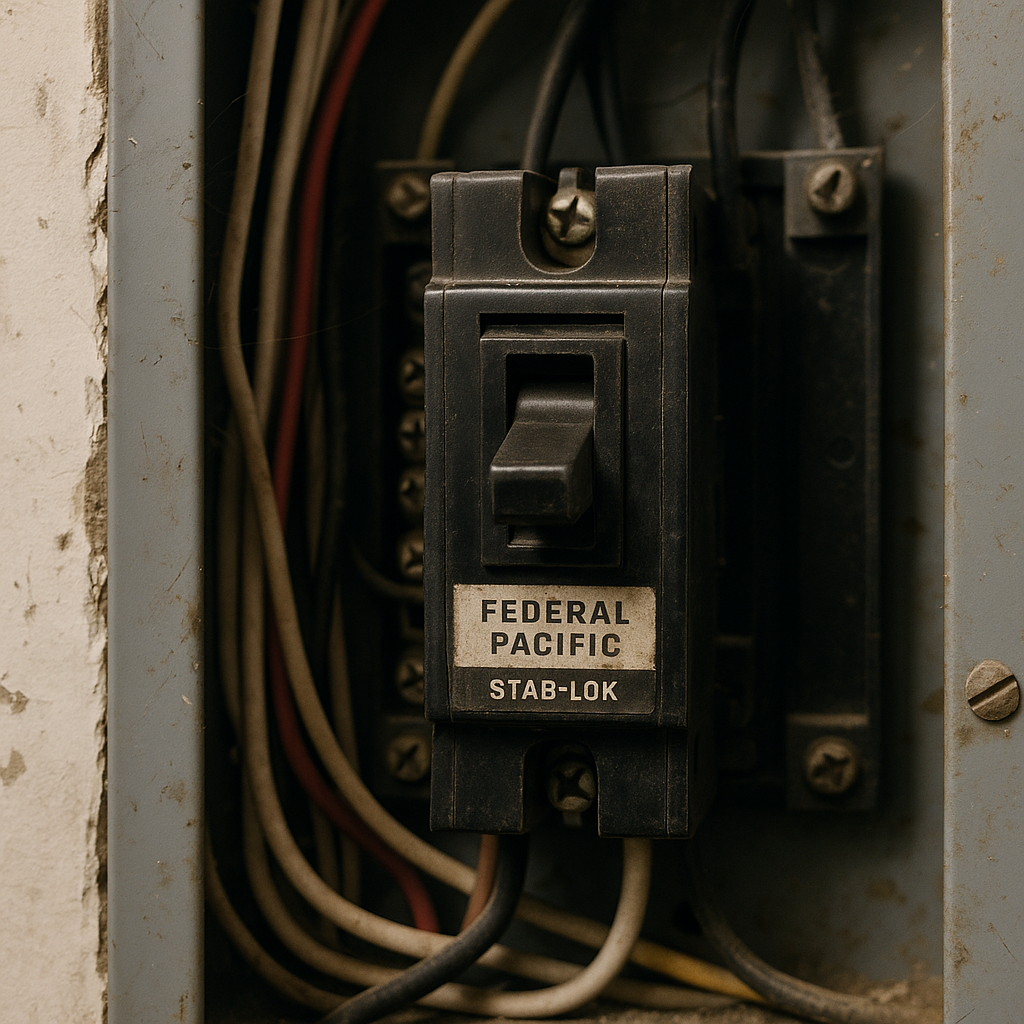
Quick Answer: Federal Pacific (FPE) "Stab-Lok" and Zinsco panels are widely regarded by electricians as a fire risk because their breakers have a well-known history of failing to trip during an overload or short. When a breaker does not trip, the wiring behind it can keep heating up. If your panel carries these brand names, have a licensed electrician evaluate it. Do not open the panel or test the breakers yourself.
A circuit breaker has one job that matters more than any other. When a circuit draws more current than the wire can safely carry, or when a hot wire shorts to ground, the breaker is supposed to sense it and cut power in a fraction of a second. That single action is what stands between an ordinary electrical fault and a wall fire. The wire heats up, the breaker trips, the danger ends before it starts.
Two panel brands from the mid-20th century have a well-known reputation for failing at exactly that job: Federal Pacific Electric, sold under the "Stab-Lok" name, and Zinsco, also sold as GTE-Sylvania or Sylvania-Zinsco. Millions of these panels went into homes built or updated roughly between the 1950s and the early 1980s. Plenty of them are still on the wall, still feeding power, and still looking perfectly normal from the outside. That last part is the problem.
How These Panels Are Supposed to Protect You
Inside any residential panel, a set of copper or aluminum bus bars carries incoming power. Each breaker clips onto that bus, taps off its share of current, and sends it out to a circuit. The breaker contains a mechanism, usually a bimetal strip that bends as it heats, plus a magnetic element for sudden shorts, that forces the internal contacts apart when current climbs too high. When it works, the handle flips to the off or tripped position, and the circuit goes dead.
Think of a breaker like the pressure-relief valve on a water heater. You almost never see it operate, and for years, you might assume the tank is simply well-behaved. But the one time pressure spikes dangerously, that valve is the only thing standing between a controlled release and a rupture. A breaker that looks fine but will not trip is a relief valve rusted shut. Everything seems calm right up until the moment it very much is not.
Why Federal Pacific "Stab-Lok" Panels Raise Concern
The concern with FPE centers on the Stab-Lok breakers themselves. Independent testing and reporting over the years found that a meaningful share of these breakers failed to trip when subjected to overload and fault conditions on the bench, or tripped only after a long delay. Testing found high failure rates in some sample sets, and while the exact numbers and the underlying history have been the subject of industry debate and litigation, the widespread professional view among electricians is that Stab-Lok breakers are a fire risk worth taking seriously.
The failure mechanism people worry about is simple to picture. If a circuit is overloaded and the breaker does not open, the current keeps flowing. The wiring in the wall keeps heating. Insulation on the conductors can degrade, connections can char, and heat builds in an enclosed cavity with no one watching. There is also a recognized concern that some Stab-Lok breakers do not seat firmly on the bus, which can cause arcing and heat right at the panel.
You can often identify an FPE panel by the labeling. Look for "Federal Pacific Electric," "FPE," or "Stab-Lok" printed on the panel door, the deadfront label, or the breaker faces. Many FPE breakers carry a distinctive look, including a small red strip or marking on the handle on certain models. None of this requires opening anything up; the brand markings are usually visible on the outer cover.
Why Zinsco and Sylvania-Zinsco Panels Raise Concern
Zinsco panels have a different but related reputation. Here, the concern often involves the connection between the breaker and the bus bar. Over time, the breaker can effectively fuse or weld itself to the aluminum bus. When that happens, the handle may still move, and the panel may still look operable, but the circuit stays energized no matter what the breaker is set to. A breaker that cannot disconnect cannot protect you.
Zinsco's aluminum bus bars add a second layer of concern. Aluminum is more prone to corrosion and overheating at connection points than copper, and once a connection starts to degrade, resistance and heat rise together in a loop that tends to worsen rather than improve. Burned, blackened, or corroded bus bars are a recurring finding when electricians open these panels.
To spot a Zinsco panel, look for "Zinsco," "GTE-Sylvania," or "Sylvania" markings on the panel or breakers. The breakers on many Zinsco panels use bright, colorful handles, another visual cue an electrician often recognizes immediately. As with FPE, the identifying marks are typically on the exterior cover or the visible breaker faces.
Warning Signs You Should Never Ignore
Because these panels can fail silently, the outward warning signs matter a great deal. Any of the following is a reason to call a licensed electrician promptly:
- A panel cover that feels warm or hot to the touch.
- A buzzing, humming, or crackling sound is coming from the panel.
- A burning smell, or any scorching, discoloration, or melted spots around the panel or its breakers.
- Breakers that feel loose, wobbly, or that you can wiggle.
- Lights that flicker or dim across the house without an obvious cause.
- A breaker that will not reset, or one that never trips even when a circuit is clearly overloaded, for example, when an appliance repeatedly stalls a circuit, but the breaker stays on.
That last sign is the most counterintuitive. People tend to treat a breaker that never trips as a sign of a healthy circuit. On these panels, it can be the opposite: evidence that the protective mechanism is no longer doing its job.
One thing you should not do is test the theory yourself by repeatedly flipping the breakers off and on or forcing them to trip. Cycling a suspect breaker can worsen a loose or arcing connection, and on a panel already under suspicion, it invites exactly the heat and arcing you are trying to avoid. Identifying the brand and watching for symptoms is your job. Diagnosing and correcting it is a job for a licensed electrician, working with the power properly managed, never with a homeowner poking around a live panel.
Why Replacement Is Usually the Recommended Fix
When an electrician evaluates one of these panels, the common recommendation is to replace the entire panel rather than patch it. There are practical reasons for that. Because the concern lives in the breaker-to-bus design and, for Zinsco, in the bus bar itself, swapping individual breakers rarely resolves the underlying issue.
Replacement breakers are also a genuine sticking point. True original stock is long out of production, and some breakers sold as compatible are aftermarket parts whose real-world tripping performance and fit are not something a careful electrician wants to stake a home's safety on. Putting a questionable replacement breaker onto a bus that may already have integrity problems does not restore the protection you actually need. A new panel with a modern bus and current-production, properly listed breakers rebuilds that protection from the ground up.
There is a paperwork dimension too. Home inspectors increasingly flag FPE and Zinsco panels during real estate transactions, and insurers have grown less willing to write or renew policies on homes that still have them. So, beyond the direct safety question, one of these panels can complicate a sale or a policy, which is part of why many owners choose to address it rather than wait.
The environment is its own factor. In a damp or salt-air setting, corrosion on aluminum bus bars and breaker contacts tends to progress faster than in a dry setting. A Zinsco bus already predisposed to corrosion has that tendency accelerated by moist, salty air working its way into the enclosure over the years, which is one more reason panels exposed to those conditions deserve a look sooner rather than later.
Frequently Asked Questions
Read the labels without touching anything live. On the metal panel door or the label behind it, look for the names "Federal Pacific Electric," "FPE," or "Stab-Lok," or for "Zinsco," "GTE-Sylvania," or "Sylvania." Visual tells help too: many FPE breakers have a small red marker on the handle, while Zinsco breakers often use bright, multicolored handles. Homes built or rewired from roughly the 1950s into the early 1980s are the most likely candidates. If you are unsure, a licensed electrician can confirm the make in minutes.
This is the trap with both brands. The concern is latent failure, meaning the panel performs normally during everyday use and only fails at the precise moment it is called upon to trip during an overload or short circuit. Years of quiet service are not evidence that the protection works, because that protection is almost never exercised. A relief valve that has never had to open has also never been proven to open. The risk is defined by the rare emergency, not the ordinary day.
Usually not a sound fix. The known concerns are rooted in the breaker-to-bus design and, for Zinsco, the aluminum bus itself, so a like-for-like breaker inherits the same weakness. Original breakers are out of production, and some parts marketed as compatible are aftermarket units whose tripping reliability and secure fit an electrician cannot vouch for. Bolting an uncertain breaker onto a bus that may already be corroded or damaged does not restore dependable protection, which is why replacement of the panel is the more common recommendation.
Frequently, yes. Home inspectors routinely note FPE and Zinsco panels in their reports, and these issues commonly surface during a real estate transaction, sometimes affecting negotiations. On the insurance side, some carriers are reluctant to write a new policy or renew an existing one on a home that still has one of these panels, and a few may require replacement as a condition of coverage. Addressing the panel ahead of a sale or policy review removes a predictable obstacle.
Treat heat, sound, and smell as urgent. A panel cover that is warm or hot, any buzzing or crackling from inside it, a burning odor, or visible scorching, melting, or discoloration all point to active heating and warrant an immediate call, not a wait-and-see. Repeated unexplained flickering across the home and breakers that feel loose belong in the same call-now category. In the meantime, avoid loading the suspect circuits and keep the area around the panel clear.
It depends on how the home is wired, and that call belongs to the electrician after an evaluation. In many cases, the main panel is the component of concern and gets replaced outright. Where a home has a separate subpanel that is also an FPE or Zinsco unit, that one may need attention too, since the same breaker-and-bus concerns apply wherever the brand appears. The scope is set by which panels carry the suspect equipment, not by a single default answer.
Have a licensed electrician evaluate your panel — replace an FPE or Zinsco unit before a hidden fault becomes a fire. Castles Electrical serves Virginia Beach, Chesapeake, and Norfolk. Call (757) 765-8222.