
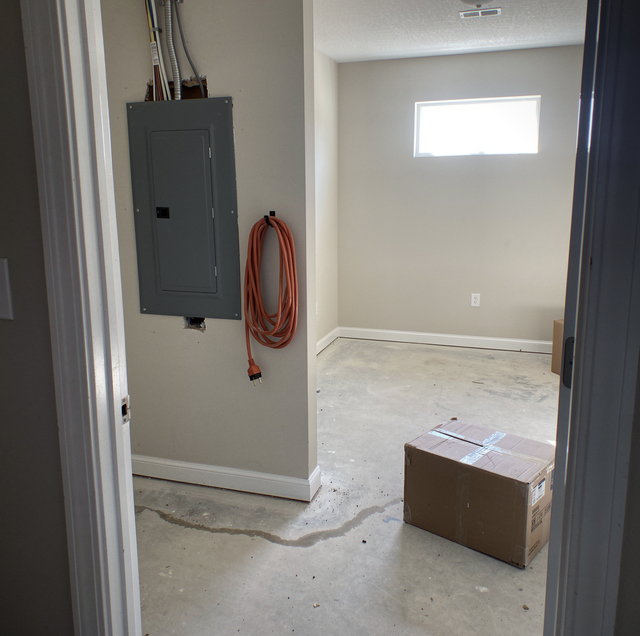
Quick Answer: Usually, yes. A short move that stays close to the electric meter is a panel job. A long move generally requires a new outdoor disconnect or a relocated meter, which constitutes a service change with the utility and an inspection.
The panel is on the back wall of the hall closet, behind the winter coats and the vacuum, and resetting a tripped breaker means pulling half the closet into the hallway first. Or it hangs beside the bathroom door, right where the remodel sketch puts the new vanity. Either way, you are asking the same thing: can it go somewhere else, and how far?
A panel can almost always move a little. How far it can go depends on things outside the house as much as inside, and each constraint below has a point where a panel move becomes a change to the service itself.
The Meter Wall Sets Where the Panel Can Start
Power reaches a house through the service. The utility's conductors arrive overhead at a mast and weatherhead, or underground through a buried lateral, enter the meter base on an exterior wall, and continue through that wall to the main breaker. In most homes, the main breaker is located inside the panel, so the builder placed the panel wherever it could be close to the meter. That is why so many closet panels hang on an exterior wall with the meter directly behind them; the closet was simply the room on the inside of that spot.
That geometry gives the easy answer first. Sliding the panel along the same exterior wall, or through to the room on the other side of the closet, keeps it within a short run of the meter. The meter and the utility's connection stay where they are, though the utility still has to cut power at the meter while the electrician works.
The threshold appears when the spot you want is on a different wall or across the house. A meter can move, but its location is not your call or the electrician's alone: the utility has its own requirements for where a meter may sit and approves any new position. With an overhead service, a meter on another wall usually needs a new mast and a new point where the utility's drop attaches. With an underground service, the lateral must reach the new meter position, which may require extending or re-trenching a line the utility may own. Once the meter moves, the service equipment itself is new, and the utility's schedule becomes part of the project.
Before the estimate visit, photograph the meter and the wall it sits on from outside, note whether the wires arrive overhead or underground, and mark the spot you want. Those three details settle most of the first conversation about reach.
How Far the Service Conductors Can Run
The conductors between the meter and the main breaker are unlike any other wire in the house. Each branch circuit has a breaker at its source, sized to its wire, that opens when that wire is overloaded or shorted. Service conductors have no breaker ahead of them on the house side. The main breaker sits at their far end, protecting everything downstream and nothing upstream. If the insulation on a service conductor fails inside a wall, the fault is fed by the utility's equipment, and that equipment is sized to protect the utility's system, not a length of cable behind your drywall.
That is why the inspector wants the main disconnect close to where the service conductors enter the building, and why the run allowed inside the house is short. How short it is is set by the local jurisdiction rather than by one national figure, so the electrician confirms it with the inspector before a new location goes on a plan.
The conductors feeding the main breaker remain energized even when every breaker in the house is switched off, and nothing inside the house shuts them off. Leave the panel cover, the meter, and that cable run to a licensed electrician and the utility.
The way past that limit is to move the main disconnect rather than stretch the conductors. A main breaker installed outdoors at or beside the meter serves as the service disconnect, and the indoor panel becomes a subpanel fed by a feeder. A feeder is protected by the breaker at its source, so it can travel much farther through the house than service conductors can. That change also affects how the indoor panel is grounded, which is part of what the inspector checks, along with whether the grounding electrode conductor reaches the new service equipment. That is how a panel ends up in a utility room across the house, and it is a service change because the service equipment is new, and installing it requires a utility disconnect and reconnect.
Clear Working Space Is the Test a Closet Usually Fails
Once reach is settled, the new spot has to pass a physical check. For a typical home panel, the inspector looks for a clear zone at least 30 inches wide, 36 inches deep measured from the panel face, and 6 1/2 feet high, with nothing stored in it and room for the panel door to swing open at least 90 degrees. The space exists for whoever works on energized equipment: room to stand square to it, see what they are touching, and step back.
A standard reach-in closet is about 24 inches deep, which falls short of that depth before a single coat goes back on the rod. The contents are the second problem. Clothing catches fire easily, and a breaker interrupting a fault arcs at its contacts. That pairing is why inspectors flag a panel in a clothes closet, even when the closet is deep enough.
A bathroom fails for a different reason. It holds the most steam and the most plumbing within arm's reach of any room in the house, and the person reaching for a breaker there is the one most likely to have wet hands and bare feet on a damp floor. Inspectors flag bathroom panels for that reason, which is why a bathroom remodel so often opens with the panel question.
If no wall within the service conductors' reach can provide the panel with that clear zone, the panel cannot stay indoors near the meter, and the answer runs back through the outdoor disconnect or to a meter elsewhere.
The New Wall Needs Depth and a Clear Column Above
A wall that passes the floor-space test still has to hold the panel. A flush-mounted panel sits in a stud bay, so the bay must accommodate the enclosure's width and depth. A panel wider than the bay means cutting a stud, and in a load-bearing wall that becomes framing work with its own requirements. Where the bay will not take it, the panel mounts on the surface instead, and the 36 inches of clear depth is then measured from its projecting face, so the room has to be that much deeper.
The column of wall space from the floor to well above the panel, as wide and deep as the panel itself, is reserved for electrical equipment. An inspector checks that no water line, drain or duct runs through it, for the plain reason that a leaking fitting above a panel drips straight onto the breakers. That rule makes the wall behind a bathroom or laundry, full of supply lines and a drain stack, a poor destination even when the room beside it looks ideal.
If the only walls that meet these conditions are beyond the service conductors' reach, you are back to the outdoor disconnect, which brings the utility and a permit into the job.
Every Circuit Has to Reach the New Spot
Moving the enclosure is the smallest part of the work. Every branch circuit in the house ends at the old panel, and each one has to arrive at the new location. Often the old enclosure stays in the wall as a junction box instead of coming out.
That leftover box has a consequence people miss. A junction box has to stay accessible, so the old panel location becomes a blank cover that can't be drywalled over or hidden behind a built-in. If the whole point of the move was a bathroom remodel, that cover stays inside the finished bathroom unless every circuit is instead run all the way back to the new panel, and that choice decides how much drywall comes open.
What arrives at the old box also changes the job. In a house wired within the last few decades, the circuits waiting there are copper cable, and extending them is routine. Older houses break that assumption. The conductors coming in may be aluminum branch wiring, which requires connections rated for aluminum, so the electrician treats each circuit as a separate decision. Or they may be knob-and-tube, which carries no ground wire to extend, leading the electrician to ask whether those circuits should be carried to the new panel at all or replaced. In those houses, the circuit count is only half the question; the other half is which circuits are worth extending.
Circuits alone never force a service change; the load on them can. If the new panel is meant to handle circuits the old one couldn't, a load calculation determines whether the service rating needs to increase, and a higher rating means new service equipment.
Where a Panel Move Becomes a Service Change
| Where the panel is going | What changes | Utility's role |
|---|---|---|
| Same wall, or the room behind the closet, within the conductors' reach | The panel and the short meter-to-panel run | Cuts and restores power at the meter |
| Farther inside, with the meter staying put | Outdoor main disconnect at the meter; indoor panel becomes a subpanel on a feeder | Disconnects and reconnects for new service equipment |
| A different exterior wall | Meter base, mast or lateral, and service conductors | Approves the new meter location and reconnects |
A service change brings a permit, the utility's schedule and an inspection before power is restored. It also changes how the move pairs with other work. If the service is being replaced for capacity anyway, the relocation rides on that project. If the closet holds an obsolete panel such as a Federal Pacific unit, nothing in it is being reused; the new panel has to go somewhere, and choosing a better spot adds mainly the circuit extensions to work that was already happening. In a newer house with a sound panel, the move stands alone, and the better spot has to be worth every circuit extension and every stretch of open drywall it brings.
Frequently Asked Questions
Not on their own. Breaker positions usually change during a relocation, so the old directory no longer matches the new layout. The electrician fills in a fresh directory at the new panel, and the inspector checks that each circuit is identified by what it serves, such as "north bedroom receptacles," rather than "misc" or a blank line.
Often, because an attached garage frequently shares an exterior wall with the meter. The catch is what lives in a garage. The clear zone in front of the panel has to stay clear during normal garage use, so a wall the car's bumper noses up to, or one lined with storage shelving or a workbench, fails for the same reason a closet does.
Over the steps, no: inspectors flag a panel located above the treads of a stairway, since nobody can stand level in front of it. Under a staircase, the problem is height. The sloped underside of the stairs rarely provides full headroom throughout the working zone, so an under-stair closet tends to fail in the same way a crawlspace would.
It is a natural moment. Adding the device while the new panel is being set puts it under the same permit and inspection as the relocation, instead of reopening the panel later.
No, and the reason sits outside the house. The meter carries a utility seal, and breaking it is a matter between the utility and a licensed electrician; the work also needs a permit and inspection.
Usually not throughout. Circuits often reach the old panel from the attic above or a crawlspace or basement below, and the extensions can follow those same routes to the new location, dropping into a wall only where the new panel sits. Walls open where a run has no attic or crawl path, such as between the floors of a two-story house.
Plan your panel relocation with a licensed electrician — have the meter wall, the working space, and every circuit checked before a new spot is chosen. Castles Electrical serves Virginia Beach, Chesapeake, and Norfolk. Call (757) 765-8222.