
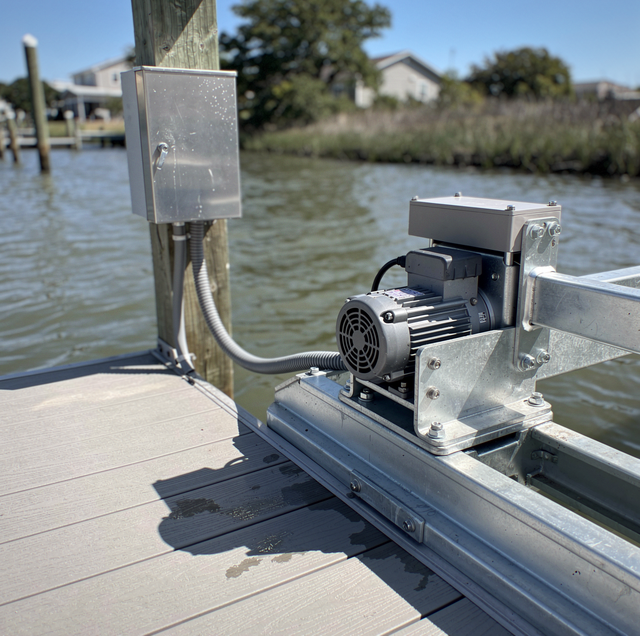
If you can wire a shed or a patio outlet, it's tempting to think you can wire a dock, a boathouse, or a boat lift the same way: run a weatherproof cable, add a GFCI, and call it done. You can't, and assuming you can is how waterfront owners like you get hurt.
A dock, boathouse, or boat lift sits where a fault does not just trip a breaker; it can leak current into the water around you, your kids, or anyone tied to your slip. That is why your waterfront wiring follows a stricter standard than the rest of your house, and why you shouldn't assume your regular electrician's outdoor work already covers your dock, your lift, or your boathouse.
Everything a Dock, Boathouse, or Boat Lift Wiring Project Actually Involves
A dock, boathouse, or boat lift project is rarely one circuit, and you'll usually end up combining five distinct types of wiring at once: lighting strung along the walkway you and your guests actually walk on, power for boathouse equipment like a sump pump or a garage-style door, a dedicated circuit built for your boat lift motor, shore power outlets where you plug your boat in while it's tied up at the slip, and wiring for any pump or drainage system that keeps the area usable after a storm. Each one draws a different amount of current, sits at a different spot relative to the waterline, and fails differently when something goes wrong. Treat all five as a single generic outdoor wiring job, and you'll likely end up with a project that's undersized in one place and overbuilt in another.
Lighting circuits usually carry the lowest load but run the longest distance, strung along a walkway that flexes with wind and boat wake. Boathouse equipment tends to draw more power in short bursts, similar to a garage door opener or a sump pump on land. Your boat lift motor requires the steadiest supply in the group, since a lift that loses power halfway through raising your boat is worse than one that never had power to begin with.
None of that makes any single piece simple on its own. Your boat lift circuit, your shore power outlet, and your dock light all wire back to the same panel, bond to the same grounding system, and get inspected against the same waterfront standard, a requirement your shed or patio job never had to meet.
Dock Wiring vs. a Standard Outdoor Circuit: Where the Difference Really Matters
Look at a dock's panel and a patio's side by side, and the parts can seem similar to you: conduit, GFCI breakers, weatherproof boxes. The difference shows up in what each system has to survive and what happens when it fails.
| Standard Outdoor Circuit (patio, shed) | Dock, Boathouse & Boat Lift Wiring | |
|---|---|---|
| What surrounds it | Open air, dry ground nearby | Open water, with swimmers and boats close by |
| Bonding scope | The circuit and its own box | Every metal part on and near the dock, tied into one grounded system |
| What a fault does | Trips a breaker, maybe damages an outlet | Can leak current into the surrounding water |
| Inspection focus | Standard outdoor wiring practice | Grounding and bonding specific to waterfront systems |
| Movement it must handle | Little to none | Flex from a floating structure, wave action, changing water levels |
Every row on that table traces back to one fact: water conducts, and a swimmer's body conducts even better than the water around you. That's the reasoning waterfront standards are built around, and it's why work that would pass on dry land can still be wrong for your dock.
Bonding and Grounding Carry the Real Weight on the Water
Bonding ties every metal part on and near a dock- the frame, the boat lift rails, a metal ladder, any underwater lighting- into one connected system that's grounded back to the panel. When that bonding stays intact, a fault has a safe path to travel, and a breaker trips as it's supposed to. When a bonding strap corrodes, a connection loosens, or a DIY repair skips the step, current can find its way into the water, and it doesn't take much to put you or anyone near your dock at risk.
Corroded, damp, or DIY dock wiring can leak current into water without tripping a breaker. If anyone feels tingling in the water, get out and cut power immediately, then have a licensed electrician inspect and re-bond the system.
This is also one of the few places an inspector looks at closely on a waterfront job. Grounding and bonding get checked on their own, separate from the rest of your property's electrical system, because the failure mode near water isn't the same as anywhere else you'd find a circuit.
Saltwater and brackish water accelerate corrosion far more than open air ever would, which is why a bonding connection that looked solid when you installed it can quietly fail within a few seasons. A loose or corroded bond usually doesn't show up as a tripped breaker or a burning smell, unlike a bad connection in your wall. It just stops doing the job, quietly, until you test it or something goes wrong near the water.
Boat Lift Power Connections and the Load They Need to Handle
Your boat lift motor draws a real jolt of current the moment it starts lifting a loaded boat out of the water, then eases into a steadier draw while it finishes the cycle. That startup surge is why lift circuits are sized and wired separately, rather than sharing a breaker with dock lighting or a shore power outlet that might be drawing current at the same time. Dedicated wiring also has to handle the environment your lift actually sits in: sun, spray, and, on a floating system, real physical movement every time the water level changes. A circuit bolted to the side of your garage that would hold up fine can fail quickly once it's asked to flex and get wet on a regular basis.
None of that changes what the lift itself needs from the panel: steady voltage and a circuit sized for its full running load, not just its average draw. Undersize that circuit and you don't just risk nuisance tripping; you can shorten the life of your motor, and replacing a motor costs a lot more than getting the circuit sized right the first time.
Shore Power Outlets and the Load They're Wired to Support
A shore power outlet looks like an oversized household plug, but what's on the other end is better suited to a small building's power needs than to a phone charger. Air conditioning, chargers, and cabin lighting can run off that one connection overnight while your boat sits at the dock.
Boats vary widely in how much power they draw at the dock. Tell your electrician what's aboard: generator, AC, chargers, so the outlet is sized right.
Your car charges for a few hours and stops needing power; your boat tied up all weekend pulls current the whole time, a load a driveway outlet never carries.
What Trips GFCI Protection on Dock Wiring Before It Becomes a Bigger Problem?
A GFCI or ELCI breaker on dock wiring is built to be sensitive, because the failure it's guarding against is current escaping into water, not into a wall. That sensitivity means it can trip for reasons that would never bother your regular household circuit: a hairline crack in a light fixture's seal, a connector that's corroding, or a pump drawing slightly more current than it used to as it wears out. None of those causes are visible standing on the dock looking at it.
That's exactly why a breaker that trips once, resets fine, and then trips again a week later deserves an actual look from you, not just a reset and a shrug. It's tempting to treat a repeat trip as an annoying but harmless breaker, not a clue about the wiring underneath it. On dry land that shortcut is usually low-stakes.
Over water, a nuisance trip can be the only outward sign that current is finding a path it shouldn't, which is exactly the kind of fault bonding and grounding exist to catch before you're in the water. Reset it again and hope it holds, and you turn a small, findable problem into the kind of hazard this article opened with.
A Licensed Dock Wiring Project, From Assessment to Final Inspection
A dock, boathouse, or boat lift wiring project usually starts with an assessment: your existing panel capacity, the layout of what needs power, and the condition of any wiring that's already in place. From there, a licensed electrician plans new circuit runs, selects conduit and fixtures rated for your wet, waterfront location, and installs the bonding that ties all metal components into a single grounded system.
Inspection is part of that process, not an afterthought tacked onto the end. A waterfront electrical inspection checks your grounding and bonding work on its own, separate from a routine outdoor wiring sign-off, before the system counts as finished.
Depending on how much of your dock is already wired, how far new circuits have to run from the panel, and how quickly you can get a permit and inspection scheduled, a full dock, boathouse, or boat lift wiring project typically takes somewhere between one and three weeks, from that first assessment to a passed final inspection. Older or more corroded systems tend to land at the longer end of that range, since more of the existing wiring usually needs to come out instead of staying in place.
Frequently Asked Questions
Yes, in almost every case. Running a lift or dock circuit off an existing outlet or a shared breaker means a fault anywhere on that circuit can take out your lighting, your lift, and your shore power outlet all at once. It also makes it harder for an electrician troubleshooting a problem on your dock to isolate what actually failed.
A floating dock rises and falls with the water level and shifts with wind and wake, so the wiring feeding your dock can't be rigid the way conduit to a fixed piling structure can be. Installers typically use flexible, wet-rated cable with slack built into your run. If your dock floats, ask your electrician whether that movement was planned for, since a rigid run on your dock tends to fail at the connection first.
Usually not, and for a practical reason: boathouse equipment like a sump pump, a lift motor, or a garage-style door draws far more current in short bursts than your lighting ever does. Put them on one circuit, and your lighting can flicker or trip every time your equipment kicks on. Separating the circuits also means an electrician working on your boathouse later can isolate that circuit without cutting power to your dock lights first.
A dock is often the tallest metal structure over open water on your property, a natural point for lightning to find ground. The same bonding and grounding that protects against electric shock drowning also gives a strike a defined path to follow, not an unpredictable one through your boat lift or your boathouse wiring instead. It's one more reason that bonding on your waterfront system isn't optional, as it might be elsewhere on your land.
It can, especially after a claim. If a fire, injury, or shock incident traces back to your dock or boat lift wiring, an insurer investigating that claim will often ask whether the work was done by a licensed electrician and whether it was permitted and inspected. Unpermitted electrical work at your dock is exactly the kind of detail that can complicate your payout, even when the wiring itself wasn't the direct cause of the loss. Keeping your permit and inspection records on hand protects you either way.
A complete project usually starts with a load calculation to determine whether your existing panel has enough room or whether a small subpanel near the water makes more sense. From there, an electrician runs marine-grade cable and corrosion-resistant fittings out to the water's edge, sizes GFCI or ELCI protection to your specific equipment, and bonds every metal component- the dock frame, boat lift rails, ladders, and any underwater lighting- into one single grounded system. Ask for photos of that bonding work before decking or trim covers it back up, since it's the part an inspector actually needs to see, and you won't get another look once it's finished. The final walkthrough should cover everything in writing before you use your dock again.
Get your dock, boathouse, or boat lift wiring checked before you are back on the water this season — a licensed electrician inspects the waterfront circuits, bonding, and grounding this work depends on. Castles Electrical serves Virginia Beach, Chesapeake, and Norfolk. Call (757) 765-8222.
