
Why Does My EV Charge Slower Than It Used To? Find the Limit
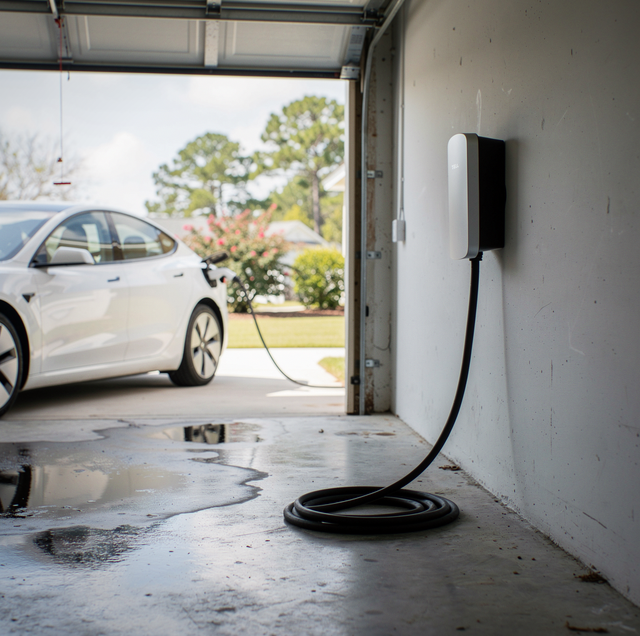
For a year, the car was full every morning. Now you plug in at the same hour, unplug at the same hour, and the app shows a number that would have looked like a typo last spring. Same spot, same cord, same habit, and less charge to show for it.
Home charging speed comes from several limits stacked in a row, and the lowest one wins. When a session slows down, one of those limits has moved. Finding out which one means walking the path in order, from the panel to the pack, rather than replacing equipment and hoping the number recovers.
The Slowest Link Sets the Speed
Power reaches the battery through a series of components, and each one has its own ceiling.
- The circuit and its breaker: These set the outer bound on what may be drawn there, and they were sized for the equipment installed at the time.
- The charging unit: Every unit has a maximum output, and many carry a configured setting below that maximum.
- The car's onboard charger: The hardware inside the vehicle that converts household alternating current into something the pack can absorb. Its rating varies by model and by trim, and it is frequently the lowest ceiling in the path.
- The cable and connector: Everything the unit sends has to pass through them intact.
- The connections at both ends: Each joint, at the breaker, inside the unit, at a plug if the unit plugs in, and at the vehicle's port, has to make clean metal-to-metal contact or it becomes a limit too.
A chain holds only what its weakest link holds, and the stronger links get no credit for their extra capacity. That is why a driver who buys a faster unit sometimes sees no change: if the onboard charger was already at the lowest ceiling, raising it further moves nothing.
One boundary before going further. Public fast charging feeds the pack directly and bypasses the onboard charger, so speeds seen at a highway stop say little about the garage. Everything below concerns home charging.
A plug or receptacle that feels warm, looks brown, or smells hot is carrying a 240-volt continuous load due to a failing connection. Stop charging and have a licensed electrician inspect it before that outlet is used again.
Temperature Is the Answer Drivers Rule Out First
Temperature explains more of these complaints than any wiring problem does, and gets dismissed early because the car behaves normally in every other respect. A cold pack accepts current slowly. The chemistry that moves charge into the cells is sluggish at low temperatures, and the vehicle holds current down to avoid damaging them. On a cold night, the car may spend the opening stretch of a session warming the pack rather than filling it, which the app reads as a session that crawled.
Heat pushes from the other side. A pack that is already warm after a long drive may charge at reduced current while the vehicle's thermal system brings it back down, and the charging unit can lower its own output if its internal electronics run hot.
Slower charging in the cold is the car protecting the battery, not a circuit fault. The tell is that it tracks conditions and clears when they change. Two sessions a week apart at very different temperatures are never comparable, and comparing them anyway is how an ordinary cold-weather night gets mistaken for equipment failure.
The Settings You Chose Once and Forgot
Somewhere in the vehicle's menus, or in the app that came with the charging unit, sits a limit set months ago. Most vehicles allow a reduced charging current, either globally or attached to a saved location, which is useful the one time you plug into a circuit you do not trust and easy to forget afterward. Most also carry a departure schedule and a charge target, and either makes a session look slow while it is simply following instructions. A car told to be ready at seven has no reason to finish at midnight.
These settings also move on their own. Software updates reset preferences; a second driver pairs a phone and brings their own profile; and a utility program enrolled last year shifts when the current may flow. Ruling this out takes a few minutes and no tools.
A Session That Starts Full Behaves Differently
A session beginning at 15 percent and one beginning at 65 percent are not the same job, even when both run overnight. As the pack fills, the vehicle reduces the current it will accept, so the upper portion of a charge takes longer per unit of energy than the lower portion. The effect is gentler on home charging than on a fast charger, because the current is lower to begin with, but it is present.
Habits drift, and that is what turns this into a complaint. A driver who once arrived home nearly empty and now tops up nightly is watching a slower-looking process with nothing wrong behind it. The comparison that means something is energy added per hour from a similar starting point, not how full the car looks at breakfast.
When a Connection Starts Going Bad
Warmth at a plug earns a phone call before you finish reading this section. A connection that has loosened, corroded, or worn produces resistance where there should be almost none, and that resistance, under a sustained load, turns into heat at that exact point. The heat further degrades the contact, and the loop tightens on itself.
The wear points are predictable. Terminals at the breaker and inside the charging unit relax over time due to heating and cooling. A plug-in unit adds two more: the receptacle contacts spread and lose grip, and the plug blades pit. Cables take abuse of their own, and a cord driven over, pinched in a door, or coiled hard at the same bend for years can be damaged inside a jacket that still looks perfect.
Equipment often reacts before a person notices anything. Many units monitor temperature at the plug or in the cordset and reduce current, pause, or trip a fault when it climbs. A session that used to hold full current but now backs off partway through may be the unit protecting itself from a bad connection, which makes the slowdown a symptom worth reporting.
None of this is homeowner territory. Do not open the charging unit, the receptacle, or the panel, and do not attempt to tighten a terminal or test anything. Warmth, discoloration, a burnt or fishy smell, or a plug that no longer grips firmly means stop using that outlet and have it looked at.
Slowdowns That Track the Rest of the House
A slowdown that appears at certain hours and disappears at other points away from the charging equipment and toward everything else drawing power at the same time. Charging shares a supply with the whole house, and on a service running near its ceiling, what reaches the car is what the other loads leave behind.
Some of that sharing is intentional. Many installations include an energy-management device that monitors household demand and pauses or reduces charging while a large appliance runs, then resumes charging once demand falls. A unit that backs off while the dryer and the range are going is doing the job it was installed to do, not failing at it. Overnight sessions usually have hours to spare, which is why this can go unnoticed for months and then look alarming the first time someone checks the app at dinner.
Timing separates the two cases. A limit that comes and goes with household activity is load management or a shared supply, whereas a limit that sits flat all night belongs somewhere else on this list.
Voltage Sag Under a Long, Steady Draw
Power delivered to the car is voltage multiplied by current, which makes voltage half the answer and the half nobody watches. Under a long, steady draw, the outlet voltage is lower than at rest. Part of that drop happens inside the house, along the run out to the parking spot. Part of it comes from the utility side, where shared equipment serving many homes at once delivers slightly below-nominal voltage during peak hours.
A vehicle pulling its rated current at a sagging voltage receives less power than the same current at full voltage, so the session stretches with no component defective. Deep or persistent sag is worth raising, because it also shortens the life of motors and electronics elsewhere in the house. An electrician can measure voltage at the outlet while the car charges, separating a drop occurring inside the house from one already present at the meter.
Walking the Chain in the Right Order
Start with the links you are allowed to touch, because they cost nothing and account for a good share of cases. Look at the vehicle's charging settings, the saved location profile, the departure schedule, and the charge target, then open the unit's app to view a reduced current setting and a session history showing when the output dropped. Line all of that up against a session you were happy with, at a similar temperature and a similar starting charge.
If the car and its settings come back clean, what remains is the circuit, the connections, and the supply, and none of those are homeowner work.
A breaker feeding the charger may be reset once. If it trips a second time, leave it off and call a licensed electrician. A repeat trip on a load running for hours points to the circuit itself.
An electrician working this problem measures actual draw against the circuit's rating, reads voltage at the outlet under load, and inspects every termination in the path for heat damage and corrosion. That covers the links nobody can see from the driveway, and it closes out the possibilities carrying real risk rather than mild inconvenience.
Frequently Asked Questions
Length adds resistance, so a long run loses a little voltage and delivers slightly less power at the car. The larger issue is what gets added to the end of a cord. Vehicle and equipment manufacturers generally prohibit extension cords, adapters, and multi-plug taps, because those connections are not built for hours of continuous current.
Most do. Level 2 units are commissioned at installation with a current limit set to match the circuit they were wired to, either via internal switches or through a configuration menu. That figure stays where it was put. If a circuit is later enlarged, the unit does not learn about it, and someone has to reconfigure it before the extra capacity is usable.
Not in the way owners expect. The onboard charger's rating does not decline with age, so a given amount of energy still moves at about the same rate. What age reduces is total capacity, so an older pack often reaches full sooner because it holds less. Range loss and rate loss are separate effects.
If they share a circuit or sit under one energy-management scheme, yes, because the available current is divided between them. Some units are built for this and can be linked in pairs or groups so they negotiate a share rather than competing. Two independent units on a single strained supply is the arrangement that produces unpredictable results.
Thermal imaging does most of the work. A termination with extra resistance runs hotter than the identical terminations beside it. Hence, an infrared scan taken while the circuit is under load shows the bad joint as a bright spot before anything is visible. A dead circuit shows nothing, so the scan occurs during an actual charging session.
It does. Many factory cordsets offer a selectable amperage draw, commonly 8 or 12 amps, with the lower setting often the default. Beyond that, a 120-volt circuit shared with a freezer or a space heater leaves less for the car and can trip under the combined load, so a dedicated receptacle behaves better than a shared one.
Have your EV charging circuit checked end-to-end — an electrician measures current and voltage under load and inspects every connection between your panel and the car. Castles Electrical serves Virginia Beach, Chesapeake, and Norfolk. Call (757) 765-8222.
