
Smart Electrical Panels: What They Do and Where They Fall Short
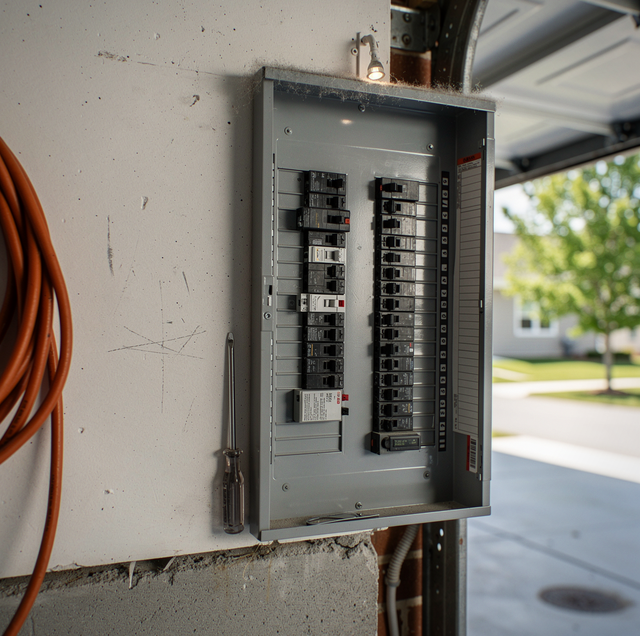
A smart panel can tell you that the circuit feeding your water heater ran for 38 minutes last night at just under 4,500 watts, and it can open that same breaker from your phone while you are three states away. A conventional panel keeps no record of either event. It distributes power and interrupts fault current, and the only status it reports is whether a handle is up or down.
Whether one is worth installing turns on a single question: would its load management let your existing service carry the loads you want to add? Where the answer is yes, it does work that would otherwise take new service-entrance conductors, a new meter base, and a utility disconnect. Where your service already has room and the appeal is the data, you are replacing distribution equipment to install a measurement instrument, and there are less invasive ways to get the data.
Three tiers sort these panels: what they measure, what they control, and what they cannot touch. The third carries more of the buying decision than the feature lists suggest.
Circuit-Level Metering Is the Part That Is New
Every breaker position in a smart panel has its own current sensor: either a current transformer whose coil output tracks the current in the conductor it encircles, or a Hall-effect element that reads the conductor's magnetic field. The panel also sees bus voltage, so it samples both together and computes real power circuit by circuit.
Motors and compressors draw current slightly out of step with voltage, so amperage alone overstates the energy consumed. Multiplying instantaneous voltage by instantaneous current yields watts; multiplying RMS amps by RMS volts yields volt-amps. Watts divided by volt-amps gives the power factor, a ratio that is invisible in any current-only reading.
Set that against a whole-house monitor, which clamps two sensors onto the service conductors and gives a single number for the home. To attribute that number to appliances, its software watches for step changes in demand and matches them against learned signatures, which works well for large, distinctive loads but struggles with small, overlapping ones. A per-circuit meter skips the guessing: the dryer circuit's number belongs to the dryer circuit.
Manufacturer specification sheets for residential circuit-level metering state accuracy within roughly 1 to 2 percent over the normal operating range, with error widening at low currents where sensor output nears the noise floor. That resolution buys something specific: whether the heat pump's backup resistance stages are firing and for how long, whether a well pump is short-cycling, and what each circuit's 15-minute demand peak reaches.
Remote and Scheduled Breaker Operation
Each position also carries an actuator, a small motor or solenoid that moves the breaker mechanism on command. The thermal-magnetic trip element stays inside the breaker and behaves as it always has: a bimetal strip that bends as it heats to catch sustained overloads, a magnetic element that snaps open on fault current. Overcurrent protection answers to the current through the device, with no network in the path.
What the app controls is the switching function: killing the water heater circuit for a week away, putting the pool pump on a schedule, shutting down a space heater's circuit without walking to the garage. The panel logs which openings were commanded and which were trips, giving a nuisance breaker a timestamped history.
A breaker opened from an app can be closed from the same app, or by a schedule you set months ago. Before anyone works on a circuit, open that breaker by hand and verify the conductors are dead with a meter.
One wear question is worth raising with your electrician. Manufacturers publish a mechanical endurance rating for a breaker, a count of open-close operations the mechanism is rated for, and those ratings differ between product lines. A breaker thrown twice a decade never approaches it; one cycled nightly by a schedule accumulates operations at a rate the device was never sized around.
Load Management Is the Capability That Changes the Math
Here, a smart panel does something a conventional one structurally cannot. Sensors on the main conductors continuously track total service current, and the controller maintains a setpoint below the service rating. As demand climbs toward it, the controller opens or throttles circuits you have designated as flexible, in a priority order you set.
The physics behind this is sound. Conductor and busbar ampacity are thermal ratings. Current heats a conductor as the square of amperage times resistance, and the metal climbs toward a steady temperature over minutes, limited by what its insulation tolerates. A control loop that keeps the running average below the rating keeps the copper at that temperature.
Speed is what makes that work. A main breaker's thermal element opens on an inverse-time curve, taking longer the smaller the overload, so an overshoot to 125 or 135 percent of rating buys minutes to roughly an hour before the bimetal reaches its trip point. That is the margin a controller operates inside when it drops a load shortly after demand rises.
The flexible loads carry storage or deferrable demand. An electric water heater's insulated tank holds heat, so cutting the element for 20 minutes doesn't show up at the tap. A car parked overnight does not care which hour it charges in. Refrigeration, sump pumps, and well pumps stay off the shed list. Charging is where this gets elegant. The panel leaves the circuit closed and tells the charging station to lower its current ceiling, which the station passes to the car.
Duty cycle on the J1772 control pilot sets the car's current ceiling at 0.6 amps per percent across the 10 to 85 percent range, so a 50 percent signal permits 30 amps and charging throttles rather than stopping.
That consequence is the whole argument for these panels. A service that could not pass a straight summation of everything connected to it can still carry that load, because the controller guarantees the largest draws never overlap. Managed load is a schedule the panel enforces, not extra amperage in the wires. Whether your shortfall is small enough for scheduling to cover is settled by a load calculation, the same one that decides whether a service upgrade is the honest fix.
The Limits Are Physical Before They Are Digital
A smart panel adds no capacity. The service-entrance conductors, the meter base, the main breaker, and the busbar keep their ratings from the day before, and every managed-load feature operates beneath that unchanged ceiling.
It also does nothing for a service that is undersized or degraded. If the conductors feeding the house are too small for its real demand, metering records the shortfall and changes none of it. If a service neutral has corroded, the panel will graph voltage swinging between the two legs as loads shift, and that graph is its entire contribution. The repair is still conductors and terminations.
Protective functions stay where they always lived. Ground-fault and arc-fault detection are properties of the breaker at a given position, so a position receives that protection only when the breaker installed there provides it. An actuator adds neither.
Resolution has a floor too. A circuit is the smallest thing the panel can see, so the kitchen circuit reports 900 watts without saying which of four appliances drew them.
The Network and the Vendor Sit Between You and the Features
The sensing hardware is local. The app, the history, the scheduling interface, and sometimes the control logic live on the manufacturer's servers. That split is where the buying question gets sharp, because the feature people install these panels for depends on somebody else's uptime.
Ask this before you commit: does the load-shedding loop execute on the panel's own controller or is it resolved through a server? A loop running on the controller keeps holding the setpoint while the modem sits dark. A loop that resolves upstream stops holding it at the worst moment, since the storm that drops your power drops your internet along the same route, and restoration is when every deferred load tries to start at once.
The support horizon deserves the same scrutiny. A panel has a service life measured in decades, while a connected product's software support runs on a much shorter clock. Ask what the panel becomes when updates stop: does it retain local metering and control, or revert to a distribution board whose breakers are proprietary to a single manufacturer? Panel lines that leave the market take their replacement breakers with them.
Where the Case Is Strong and Where It Is Thin
The strongest case is a sound, adequately rated panel in a house that wants to add load. You have a 200-amp service in good condition, and an EV charger, a heat pump, and a heat-pump water heater push the calculation beyond what it supports when everything is running at once. A service upgrade means new conductors from the weatherhead or the underground lateral, a new meter base, utility coordination, and a day without power. A managed panel reaches the same outcome by making the overlap impossible.
Battery storage is the second strong case. The panel partitions backed-up circuits from the rest in software, removing the need for a separate critical-loads subpanel and letting you change what stays alive during an outage without rewiring. Solar fits the same picture, since the inverter's output lands on its own metered position.
The thin case is a panel that already has capacity and open slots, where you simply want visibility.
| Approach | What it measures | What it controls | Displaces a service upgrade |
|---|---|---|---|
| Clamp-on monitor at the mains | Whole-house demand, appliances inferred | Nothing | No |
| Add-on circuit sensors in the existing panel | Each fitted circuit directly | Nothing | No |
| Smart panel | Every breaker position directly | Breaker state, schedules, priority shedding | Yes, where the shortfall is timing |
Monitor manufacturers list channel counts of 8 to 16 circuit sensors on their expanded models, which covers the large loads in a house without touching the distribution equipment. Only one row changes what your service can carry.
Frequently Asked Questions
Yes, and it leaves the service entrance alone. A smart subpanel is fed by a breaker in the existing main panel, and you move the flexible loads to it: the charger, the water heater, the dryer. The controller then watches that feeder breaker's rating as its setpoint rather than the service rating. Everything left behind in the old panel stays unmetered and unmanaged.
It can, but the setpoint has to be re-referenced when the transfer switch moves the house onto generator power. A standby unit's output ceiling is far below a 200-amp service, so a controller holding its utility setpoint would let demand exceed what the generator produces. The panel has to know which source is live and apply a different limit to each, a specification question to settle before equipment is ordered.
No. A meter records consumption, and recording it changes nothing about the amount. The one mechanism by which the panel affects what you pay is moving a deferrable load into an hour your utility prices lower, which requires a rate that prices hours differently. At a flat rate, shifting the car charger to the middle of the night leaves the total unchanged.
From commissioning. The electrician maps each breaker position to the load it feeds and enters that name into the software during setup, so the panel stores a position and a current reading, while the identity on that wire comes from whoever typed it in. A channel labeled wrong produces confident, wrong data indefinitely, so ask that the mapping be verified circuit by circuit with a known load switched on.
The trip curve belongs to the breaker, and remote operation is a separate mechanism bolted alongside it. One mechanical detail is worth knowing: a tripped breaker parks its handle in a center position between on and off, distinct from a handle switched off deliberately. That center position is how the panel tells a fault from a commanded opening, and why resetting a tripped breaker means pushing the handle fully to off first.
Open the door and read the label. The bus rating is a separate stamped number from the main breaker size, so a panel rated 125 amps on the bus is a 125-amp panel, regardless of which breaker is bolted to it. Read the manufacturer and date on the same label. If it is scorched or unreadable, or the panel carries a brand whose breakers have been discontinued for decades, replacement comes before any smart-panel conversation.
A load calculation belongs ahead of any panel shopping — a measured demand profile tells you whether load management would cover your shortfall or whether the service itself needs work. Castles Electrical serves Virginia Beach, Chesapeake, and Norfolk. Call (757) 765-8222.
