
Your Water Line’s Bonding Jumper — and What Removing It Does
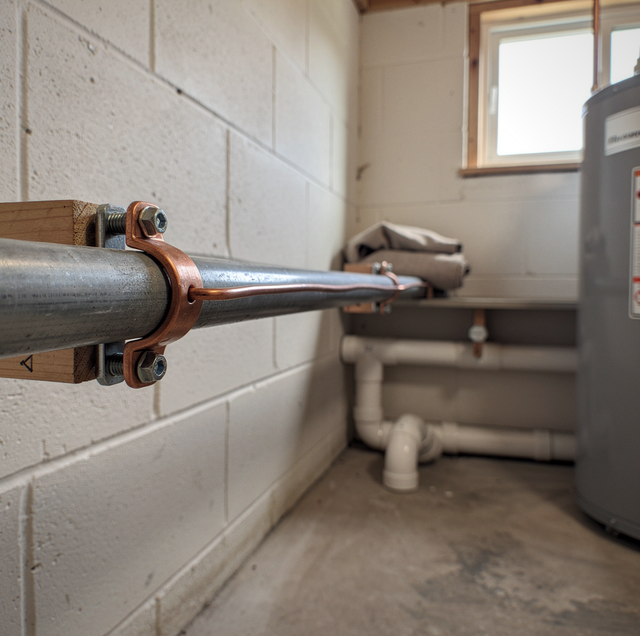
Two clamps and a short length of copper are the whole of the part. One clamp bites onto the metal water pipe near where it enters the house, the other lands on the grounded metal at your service equipment, and the wire between them is short enough to disappear behind a water heater or a bank of shutoffs.
You are more likely to meet it in its absence. A plumber cut a length of copper out of your line last week and put plastic in its place, or a water heater came out on a hand truck and a new one went in, and a wire that was doing something specific is now clamped to a piece of pipe in a dumpster.
Your Metal Plumbing Is Part of the Electrical System
Copper and galvanized steel conduct. Run a continuous metal line from the street into a house and out to the fixtures, and you have built a large branching conductor that reaches a bathtub at one end and a water heater at the other. Nobody draws it that way on a plan, and it behaves that way regardless.
The bonding jumper is the wire that makes that accidental conductor deliberate. It ties the piping to the same grounded metal that the rest of the system already sits on, so a fault reaching your plumbing is handled as a fault rather than remaining an energized surface with no connection.
What a particular house calls for is a question for a licensed electrician and the authority that inspects work where you live, and the answer moves from place to place. What the wire physically does moves nowhere, and that is the part worth knowing before a plumber opens your line.
What Breaks Continuity Without Anything Looking Wrong?
Continuity is a series property. The path is only as good as its worst joint, and one insulating fitting anywhere along the run ends it, whatever sits on either side. Plumbing broken this way looks finished, holds pressure, and delivers full flow at your fixtures.
A dielectric union at a water heater does it without anyone reaching for a cutting tool. The union carries an insulating bushing inside the fitting to prevent the galvanic couple between copper and steel when they touch. A filter or a softener spliced into the line does the same job with a plastic body, and a section of copper swapped for PEX does it outright.
Where a component sits in the middle of a run and interrupts it, a second short conductor specifically bridges that component, clamped to the pipe on each side. That one is easier to lose than the wire at the service equipment, because it lives on the fitting a plumber in your utility room is about to unscrew.
A Swap and a Repipe Take the Wire Out Two Different Ways
A water heater swap is a small job with a specific shape. The unions above the tank come apart, the flue and the gas or the circuit come off, and the tank goes out the door on a hand truck with its nipples and its unions still attached. If a jumper was bridging those unions, it went with them, clamped to steel that is now on a truck. The new tank arrives with its own nipples and unions, and the plumber makes those connections in the order that gets your hot water back the same afternoon. Nothing in that sequence puts a hand on the wire, because the wire was never part of the water connection. What makes it hard to notice afterward is that the connection at your service equipment, the one you can walk over and see, has not moved.
A repipe takes it out differently and takes more of it. The copper comes out in lengths, and one of those lengths is the piece the clamp was sitting on, so the part itself leaves your house instead of staying behind. PEX or CPVC goes in behind it, and the new line does not conduct at all, which means no equivalent surface exists to clamp the wire back onto. What survives is patchy: a steel water heater in the garage, a length of galvanized in a wall nobody opened. Those are separate pieces of metal now, and a piece of metal is not a path. An electrician walking your house afterward is not putting a wire back where it was; they are working out what is still continuous and where the connection has to land given what the plumbing has become.
Who Checks the Bond Once the Plumbing Work Is Signed Off?
The question has a structural answer, and it is not about anyone being careless. A plumbing job is quoted and inspected as plumbing, an electrical job as electrical. The wire in question is a piece of electrical equipment living on a water pipe, and it sits in the seam between those two scopes.
Walk through the day itself. A repipe crew arrives, opens walls, runs a new line and pressure-tests it, then walks the house with you, checking pressure and anything still weeping at a joint. Those are water checks, and the crew is right to make them, because water is what they were hired to control. No electrician was on site. If one comes later for something unrelated, a panel label or a bathroom circuit, your water line is not on that call sheet either, and the clamp sits several feet from wherever the work is, on a pipe somebody else has already signed off. No process failed here. The wire belongs to a process neither trade ran.
The one point where this is easy to solve is while the pipe is still open and the clamp has bare metal to land on. Once the wall closes, the same work needs somebody to find the pipe again.
Before a water-heater swap or a repipe, ask your plumber to photograph the clamp and the pipe it lands on, so the replacement can be matched to what was there.
It survives both jobs for that reason. Each one was finished correctly, and the piece that fell between them was never on either list.
Confirming It Takes a Look and a Measurement
The look comes first, and it is a short one. An electrician follows the water line from where it enters your house to the first place a clamp could sit, and either there is a clamp with a conductor in it, or there is bare pipe. The same walk happens at your service equipment, where the other clamp either holds a wire or holds nothing at all.
The measurement covers what the look leaves open. A clamp that is present can still be sitting on paint or corrosion, and an intact conductor can be landed on a fitting that no longer connects to anything upstream. A low-resistance measurement across the two ends separates a connection that is there from one that only appears to be.
A tingle from a faucet or an appliance case is a live-fault symptom. Electrical safety guidance counts even a mild shock as a warning sign in a home's wiring, so stop using that fixture and call an electrician without testing it again.
A Bond Can End at a Fixture With No Pipe Removed
A path can end at a sink with every inch of pipe in your house still in place. That failure looks nothing like a pipe job, which is why it outlasts one: no fitting came out, and the copper on both sides is exactly where it was.
The break is the flexible supply hose. Where a braided line with a plastic core replaces rigid copper between the angle stop and the faucet, the metal-to-metal route from the cold line through the mixer valve to the hot line is gone at that fixture, even though both lines are still copper in your wall.
A braided hose is a plumbing part chosen for a plumbing reason, and it interrupts the continuity the jumper is meant to maintain. Neither trade had a reason to look.
Frequently Asked Questions
The equipment grounding conductor in your wiring runs with the hot and neutral of one circuit, out to the devices that circuit feeds, and stops there. It gives a fault at your dishwasher or your dryer a path back. It does not travel sideways into the plumbing, because no branch circuit lands on a pipe. Your piping is a separate metal system, and joining it to the rest requires its own conductor, landed at two points you can see.
A bonding connection holds metal against damp metal under pressure for years, so it is a mechanical part selected to a pipe size. A listed pipe ground clamp carries a safety listing and takes a #4 to 4/0 conductor; the clamp size is chosen by the pipe diameter, one size for 1/2 to 1 inch IPS and a larger size for 1-1/4 to 2 inches. The clamp on your old pipe may not fit what your plumber puts in your wall.
The pipe end of it is a clamp on a pipe, and a plumber can fit that. The other end is not plumbing at all: it terminates on the grounded metal of your service equipment, inside the enclosure holding your main disconnect. The job stops being plumbing there and becomes electrical work. If your plumbing crew is still on site, the useful thing you can do is tell them the wire existed and where it landed.
PEX and CPVC conduct nothing, so along a run made entirely of them, there is no metal path to maintain continuity. Metal objects at the ends of that run can survive it, such as a steel water heater or a length of galvanized pipe in a wall nobody opened. Each is its own piece of metal now. An electrician confirms what in your house is still continuous before deciding where anything on your system lands.
Yes, more than a like-for-like swap would. Your tank comes out with its nipples and unions, and a tankless unit does not use the same fittings, so the pipe geometry in your house is rebuilt instead of reconnected. If a jumper bridged your old unions, nothing on the new unit is shaped like what it was clamped to. Ask your electrician to look there while your plumber is still on site.
No. That block compares the relationship among three slots at one receptacle face, and your piping is not one of the three. The answer lives on the pipe. One place to look is at your water meter, where a jumper clamped on both sides is there precisely so the metal path holds when the meter itself comes out, which is not something you would ever see at an outlet.
Book the electrician while the plumbing is still open — the bonding clamp goes back onto bare metal at the pipe before the wall closes and the crew moves off the job. Castles Electrical serves Virginia Beach, Chesapeake, and Norfolk. Call (757) 765-8222.
