
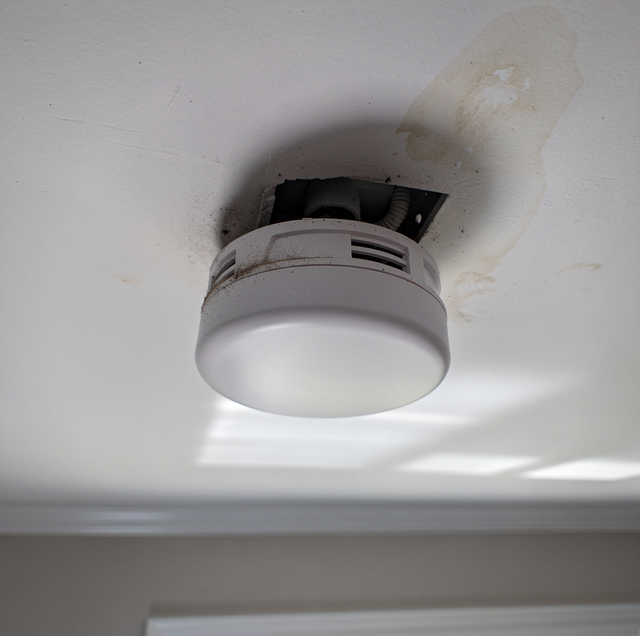
Yes. A hardwired smoke or carbon monoxide alarm draws its power from the house, but the part that senses smoke or gas wears out on its own clock, and house power does nothing to stop that. A smoke alarm is built to serve about 10 years from the manufacture date printed on it. A CO alarm has a shorter life, roughly 5 to 10 years depending on the model, and it carries a built-in end-of-life warning. Your alarm's own label is the authority here: the date on the back sets the schedule, not the day it went up on the ceiling.
Why the Sensing Element Wears Out
Every alarm in the house does two jobs. It senses, and it sounds. The horn and the circuit board can keep working long after the sensor has drifted, which is why an old alarm can pass a button test and still be a weak detector.
Ionization sensors: An ionization alarm holds a tiny radioactive source between two charged plates. The source ionizes the air in the chamber so a small, steady current flows across the gap. Smoke particles entering the chamber attach to those ions, cutting the current, and the drop trips the alarm. This design suits the small particles of a fast, flaming fire. Over years, dust, cooking film, insects, and corrosion on the plates shift the resting current the electronics treat as normal, and the alarm's judgment of what counts as smoke shifts with it.
Photoelectric sensors: A photoelectric alarm has a light source and a light sensor set at an angle inside a dark chamber, so in clean air the beam never reaches the sensor. Smoke scatters the light onto it, and that trips the alarm. This design suits the larger particles of a smoldering fire. Dust settling in the chamber scatters light too, and the light source itself can dim with age so that the chamber can drift toward nuisance alarms in one unit and toward a late response in another.
Some alarms combine both sensor types in a single housing, and both still age.
Electrochemical CO cells: A CO alarm senses gas through a sealed cell of electrodes in an electrolyte. Carbon monoxide reacting at the sensing electrode produces a current proportional to the amount of gas present. As the cell ages, the electrolyte and the electrodes lose the ability to produce that current reliably, and the cell cannot be serviced or swapped out of the housing. That limited cell life is why CO alarms get a shorter service window and why they announce their own end of life.
Reading the Date on the Back
Each alarm carries a label on its back or side. Depending on the model, it prints a manufacture date, a replace-by date, or both. Where only a manufacture date appears, count forward from it using the service life stated on that label. A unit installed years after it was made has already used some of its life on a shelf, so a two-year-old installation can already be well into its service life.
On a hardwired unit, the label faces the mounting plate, which puts it out of sight. If the alarm has never been checked and nobody knows when it went up, treat it as undated until someone reads the label. Yellowed plastic is a clue to age, though some housings discolor from light or smoke exposure and color alone is no proof either way.
An alarm with no readable date at all, or one whose date has passed, has no remaining service life to rely on.
The Backup Battery Is Only Part of the Alarm
A hardwired alarm runs on the 120-volt branch circuit feeding its ceiling box. The backup battery keeps it working when that circuit loses power, during an outage or a tripped breaker. On some models, the backup is a replaceable 9-volt or AA cell; on others, it is a sealed lithium battery built to last the life of the unit.
A fresh backup battery clears a low-battery chirp. It does not restore a sensor. An alarm with a new battery and a 12-year-old chamber is still a 12-year-old detector, and the quiet after a battery change can hide that. A sealed-battery unit reaching the end of its battery life signals that the whole alarm has reached the end of its service, because there is no battery door to open.
A power indicator light on some models shows that house power is reaching the alarm. That light confirms supply, and says nothing about the sensor.
Chirps, Nuisance Alarms and a Silent Test Button
Alarm sounds carry specific meanings, and reading them correctly decides whether the next step is a battery, a replacement, or leaving the house.
| What the alarm does | What it means |
|---|---|
| A single chirp about once a minute | Low backup battery on units with a replaceable cell |
| A chirp that continues after a fresh battery goes in | Can be the end-of-life signal; a battery not fully seated, or a unit still holding its low-battery memory, can also keep it chirping |
| Three long beeps, a pause, then repeating | Smoke alarm pattern; treat as a fire |
| Four short beeps, a pause, then repeating | CO alarm pattern; get everyone outside |
| Alarms while cooking or after a hot shower | Particles or steam reaching a nearby sensor, or a dusty aging chamber |
| No sound when the test button is pressed | No backup battery and no house power, or a failed horn or circuit |
| Every alarm in the house sounds at once | One unit sensed smoke or CO and signaled the rest over the interconnect; treat it as a real alarm and get everyone out until the source is known |
A test button proves the horn and the circuit respond. On some units, it does not prove the chamber still reacts to real smoke at the level it did when new, and that gap is what the date on the back covers.
End-of-life warnings differ between models. Some repeat the low-battery chirp, and a new battery cannot stop it; others use a distinct chirp pattern or a display message. The label on the unit decodes its own pattern.
A sounding CO alarm means everyone leaves the house now and calls emergency responders from outside. Pulling the alarm off its ceiling box to silence it leaves the gas undetected, and the live wiring behind it belongs to an electrician.
Replacing One Alarm or the Whole Interconnected Set
Where hardwired alarms are interconnected, the link is an extra conductor in the cable between ceiling boxes, and some systems link wirelessly instead. When one unit senses smoke or CO, it sends a signal over that link and every linked alarm sounds. A fire starting in a garage or a basement wakes people in the bedrooms because of that link.
Age decides the scope: Alarms installed together can share a manufacture date and reach their replace-by dates within the same stretch. Replacing only the unit that chirped leaves the others close behind it, still aging on the same schedule. Where the dates on the backs differ, a single replacement can be the right call, provided the others still have service life left.
Compatibility decides the parts: The interconnect signal is not universal. Alarms from different makers or from different generations of the same product line may fail to trigger each other on the shared wire. A new unit that cannot communicate with the rest of the chain leaves you with alarms that sound in isolation. When the original model is no longer made, and no compatible unit is listed, the whole set changes so that every alarm on the line can signal every other.
Mixing smoke and CO on one line: Some product families let smoke, CO, and combination units share an interconnect, each sounding its own pattern. That works only with units listed as compatible with each other, so the choice of one replacement model can set the choice for the rest.
What Replacement Involves at the Ceiling Box
Swapping a hardwired alarm is electrical work at a live ceiling box, and it belongs to a licensed electrician, with the circuit off at the panel for the whole job. Once the old unit and its mounting plate are down, the open box shows things nobody sees from the floor: scorched or brittle insulation, loose splices, a broken interconnect conductor, or signs of careless earlier work. Conductors in some older ceiling boxes have been heated for years by a light fixture sharing the box, and brittle insulation there is a repair of its own. With the new units up and power restored, every alarm on the line is tested to confirm one unit's signal sets off all the others.
The work also produces a record of when each alarm went in and what model it is, which settles the next replacement date without guesswork.
Frequently Asked Questions
Yes. A combination unit houses both sensors in a single sealed housing, and when the shorter-lived CO cell reaches the end of its life, the entire alarm is replaced, including the smoke sensor. Neither sensor can be swapped out on its own, so the combination unit's life is set by its CO cell.
A battery near the end of its charge has rising internal resistance, and that resistance climbs further as the air cools. When the house drops a few degrees overnight, a weak backup battery can dip below the alarm's low-battery threshold, chirp until morning, and then go quiet as the house warms up.
A heat alarm responds to temperature, not smoke, and fixed-temperature models trip at a set point, 135 degrees Fahrenheit on some units and higher on others. That makes it a fit for garages, attics, and spots near kitchens where smoke alarms nuisance-trip. It is a supplement for those spaces and does not replace smoke alarms in sleeping areas and hallways.
Yes. Options include alarms with high-intensity strobe lights, bed shakers placed under a pillow or mattress, and alarms that sound a low-frequency 520 Hz tone, a tone chosen because it wakes people with mild to moderately severe hearing loss who can sleep through a standard high-pitched horn. Hardwired strobe units need their own wiring at the ceiling or wall box.
Yes. Heat, soot, and heavy smoke from a fire can damage the sensing chamber and the circuit board of any alarm that sat in that smoke, whatever the date on its back says. After a fire or a heavy-smoke event, including a bad kitchen fire, the exposed alarms are replaced.
On some models, the unit that first sensed smoke or CO flashes its indicator light in a different pattern from the alarms it set off, and some keep that indication for a while after the sound stops. Checking each unit's light while the house is safe shows which one triggered the chain, and which room to look at.
Put hardwired smoke and CO alarm replacement on the calendar — every unit's date is read, expired alarms come down, compatible ones go up on the existing interconnect, and the whole line is tested to sound together. Castles Electrical serves Virginia Beach, Chesapeake, and Norfolk. Call (757) 765-8222.