
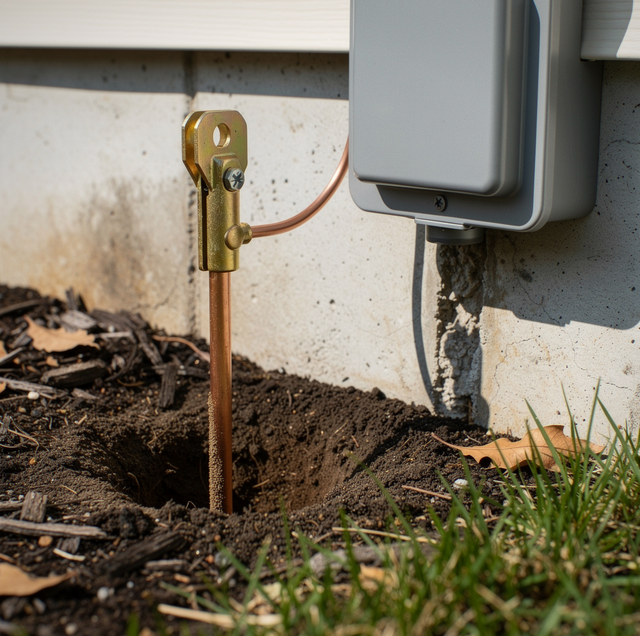
A grounding electrode system has three parts joined in a line: an electrode in the earth, which on an older house can be a metal rod driven near the meter, a clamp gripping the top of that electrode, and a copper conductor running from the clamp back to the service equipment. Whether an old rod still does anything turns on a split between two kinds of protection. The rod ties your electrical system to the earth, while the wire that trips a breaker when a hot conductor touches a metal case runs back to the panel rather than through the soil. Pairing each protective job with the part that performs it frames the rest of the answer.
| Protective job | Part that performs it | Does the rod take part? |
|---|---|---|
| Clearing a short from a hot wire to a metal case | Equipment grounding conductor and the neutral-to-ground bond at the main panel | No |
| Limiting voltage from lightning or a utility surge | Grounding electrode system | Yes |
| Holding the system's reference to earth | Grounding electrode system | Yes |
| Giving a surge protector somewhere to send energy | Grounding electrode system | Yes |
| Protecting a person at an outlet | GFCI protection | No |
What the Rod in the Ground Is For
The soil under a neighborhood is the one reference every piece of the power system shares. The utility's transformer has its own connection to earth, and your electrode connects your service to the same ground. Tying both ends to earth pins your system's voltage relative to the dirt under your feet and to the plumbing, framing, and metal in contact with it. A service with no earth connection still runs, but its voltage to ground is held nowhere in particular and can drift.
The second job arrives from outside the house. A lightning strike near the lines, a switching event on the utility side, or a higher-voltage line falling across the wires feeding your street can push a spike onto your service conductors. The electrode provides a path for that energy to enter the soil at your service entrance, which limits how high the voltage inside the house can climb relative to earth. It does not erase the spike, and it protects no single appliance on its own.
That same route is where a panel-mounted surge protector sends the energy it diverts, so a whole-home device is only as effective as the connection between your panel and the electrode behind it.
An old rod can still do all three jobs. What ends them is a break in the line from panel to clamp to rod, or a rod corroded away below grade, not age alone.
Where Fault Current and Shock Protection Run Instead
Clearing a fault: When a loose hot wire touches the metal case of a dryer or a furnace cabinet, the breaker must see a current large enough to trip it quickly. That current flows around a copper loop. The equipment grounding conductor carries it from the case back to the panel; the bond between the ground bar and the neutral in the main panel hands it to the neutral, and the neutral returns it to the utility transformer. The earth sits outside that loop. Soil is a poor conductor, so a fault forced to return through your rod, across the ground and up through the utility's own electrode would drive a small current, too small to trip an ordinary breaker, while the appliance case stayed energized. A brand-new rod would not change that, because the rod was never the return path for a fault.
Protecting a person at an outlet: A shock happens when current passes through a body touching something live and something connected to ground at the same moment. A sound rod does not stop that current. A GFCI does, by comparing the current leaving on the hot conductor with the current returning on the neutral and cutting power when the two differ. An older circuit with no equipment grounding conductor lacks the fault-clearing path at its outlets, however healthy the rod outside is.
A sound rod and an unsafe outlet can exist in the same house, and a corroded rod is not, by itself, a shock hazard at a receptacle.
An Older House Can Lean on More Than One Electrode
The rod is one kind of electrode among several. A metal water service running underground from the street contacts a long stretch of soil and serves as an electrode where it is present. Steel reinforcing bar within a concrete footing makes contact with the earth through the surrounding concrete. A bare copper ring buried around a foundation does the same job. The grounding electrode system is whichever of these a house has, tied together so they act as one.
An older house can rely on its underground water pipe as the main electrode, with a rod added later or never added, and a plumbing job that swaps that pipe for plastic takes the electrode out of the system without anyone touching an electrical part.
Footing steel in an older house can sit in the concrete unconnected, since it was poured before anyone planned to use it as an electrode. Which electrodes serve a given house is determined by tracing the conductor, not by assuming based on the house's age.
Where the Clamp and Conductor Wear Out
The rod below the soil is out of sight, its condition determined by the surrounding ground. The pieces that change in ways you can see sit on the surface.
The clamp: A bronze or copper-alloy clamp squeezes the conductor against the top of the rod. Moisture held against that joint, dissimilar metals in contact, and years of wetting and drying can corrode the contact surfaces, and a clamp can look whole from the outside while the metal-to-metal contact under it has degraded. Shifting soil, a mower wheel, or a stray kick can also loosen it on the rod.
The conductor: The copper between the wall and the rod is exposed to anything working near the foundation. A string trimmer or an edger can nick or sever it. A crew replacing siding can cut it, reroute it, or seal it behind new panels where nobody sees it again.
A nicked grounding conductor can look sound from a step away. Strands broken under a scuffed spot, or copper cut partway through, shrink what the wire can carry, and nothing inside the house changes to announce the damage.
The connection's surroundings: Regarding a raised flower bed or a fresh layer of mulch, they can bury a clamp that was installed to sit in open air. A deck built beside the meter can put the rod top under framing where nobody can reach it.
When the Grounding Wire Carries Current
On a healthy system, the grounding electrode conductor carries little or no current. That changes when the service neutral fails. The neutral carries the return current for any imbalance between the two halves of your panel's load, and if its connection at the meter, the service drop, or the utility's equipment degrades, that current looks for another path back. The grounding conductor, the rod, the metal water piping, and the soil can all become part of that detour. The copper running down your exterior wall can then carry current while every light in the house still works.
That detour is the reason a loose clamp or a cut conductor stays exactly as found. Tightening, cutting, or reattaching it can put your hands across the gap that current is bridging.
Opening the panel or meter base to find the other end of a cut grounding wire exposes service conductors that stay energized ahead of the main breaker. An electrician handles anything behind those covers.
Driving a new rod is not a homeowner fix either. The gas line, the water service, and underground electric can all run through the strip of soil beside the meter, and a new rod does nothing until it is connected into the existing system at the service equipment.
Tracing the Line from Panel to Electrode
The check starts at the service equipment: the main panel in some houses, a meter base or an outdoor disconnect in others. The electrician identifies where the grounding electrode conductor terminates, confirms the bond between neutral and ground in the main panel, and traces the conductor through the wall to each electrode it reaches: the rod, the water pipe entry, or both.
Along that route the electrician looks at the conductor for cuts, nicks, splices and places where it has been buried or boxed in, and at each clamp for corrosion, looseness and whether it can be reached. Then the connection is tested, because a clamp that looks tight can still sit on corrosion, and a measurement is what separates a working path from a connection that merely looks sound.
A cut conductor, a missing clamp, or an electrode that no longer connects is damage, and it is corrected when found. An intact but dated system, such as a single old electrode or a smaller conductor than is used in current work, is a different finding, and its timing can follow the next piece of panel work.
Panel Work Is When the System Gets Brought Up to Date
When a panel is replaced, or a service is upgraded, the grounding electrode conductor comes off the old equipment and lands on the new, and the inspector looks at the electrode system as part of the same job. What the house needs at that point, including which electrodes, what size conductor, and how the pieces connect, is decided by the local inspector and the current rules, not by what the original builder installed.
That makes panel or service work the natural moment. The panel end of the conductor is already open, the service is already de-energized, and one inspection covers the grounding along with the new equipment.
If the check turns up damage outside, the repair does not wait for a panel project. If the line from panel to electrode is intact and a panel replacement is already planned, folding the grounding work into that job is the efficient route.
Frequently Asked Questions
No. A lightning protection system is a separate installation: pointed air terminals along the roof, heavy down conductors running to the ground, and its own electrodes. It is built to intercept a direct strike on the building, which the service rod is not. Where a house has both, the two electrode systems are bonded together so they rise to the same potential during a strike, rather than arcing between them.
Yes, with a clamp-on ground resistance tester that reads the electrode in place, provided it is one of several parallel paths back to the utility's grounded system. The older fall-of-potential method drives two temporary test stakes into the soil at set distances from the rod, measures the distance from the rod to the nearer stake, and, for that test, first isolates the electrode from the rest of the system.
It can. Moisture and dissolved minerals in the soil carry the current, so the same rod reads differently after a long dry spell than after a wet week. That swing is why one reading is a snapshot of the conditions that day, and why an electrician looks at the connection's condition as well as the number.
It should. The coaxial line passes through a grounding block at the point where it enters the house, and that block is bonded to the electrical grounding electrode system at a point near the service. When a cable installer drove a separate rod and left it unconnected, the two systems can sit at different voltages during a surge, and a television plugged into both takes the difference.
A clamp listed for direct burial carries a marking saying so, the letters DB or the words direct burial, cast or stamped into its body. A clamp without that marking that has ended up under soil or mulch after yard work is one an electrician looks at closely, since it was not built for that exposure.
A sleeve protects the conductor from damage by a mower, a car bumper, or foot traffic. When that sleeve is steel, it is bonded to the conductor at both ends. Left unbonded, steel surrounding a single conductor impedes the fast-rising current of a surge, which is the current the wire exists to carry.
Commission a grounding and bonding check as part of a panel evaluation — it follows the grounding conductor out from the panel and tests every clamp and connection it reaches. Castles Electrical serves Virginia Beach, Chesapeake, and Norfolk. Call (757) 765-8222.