
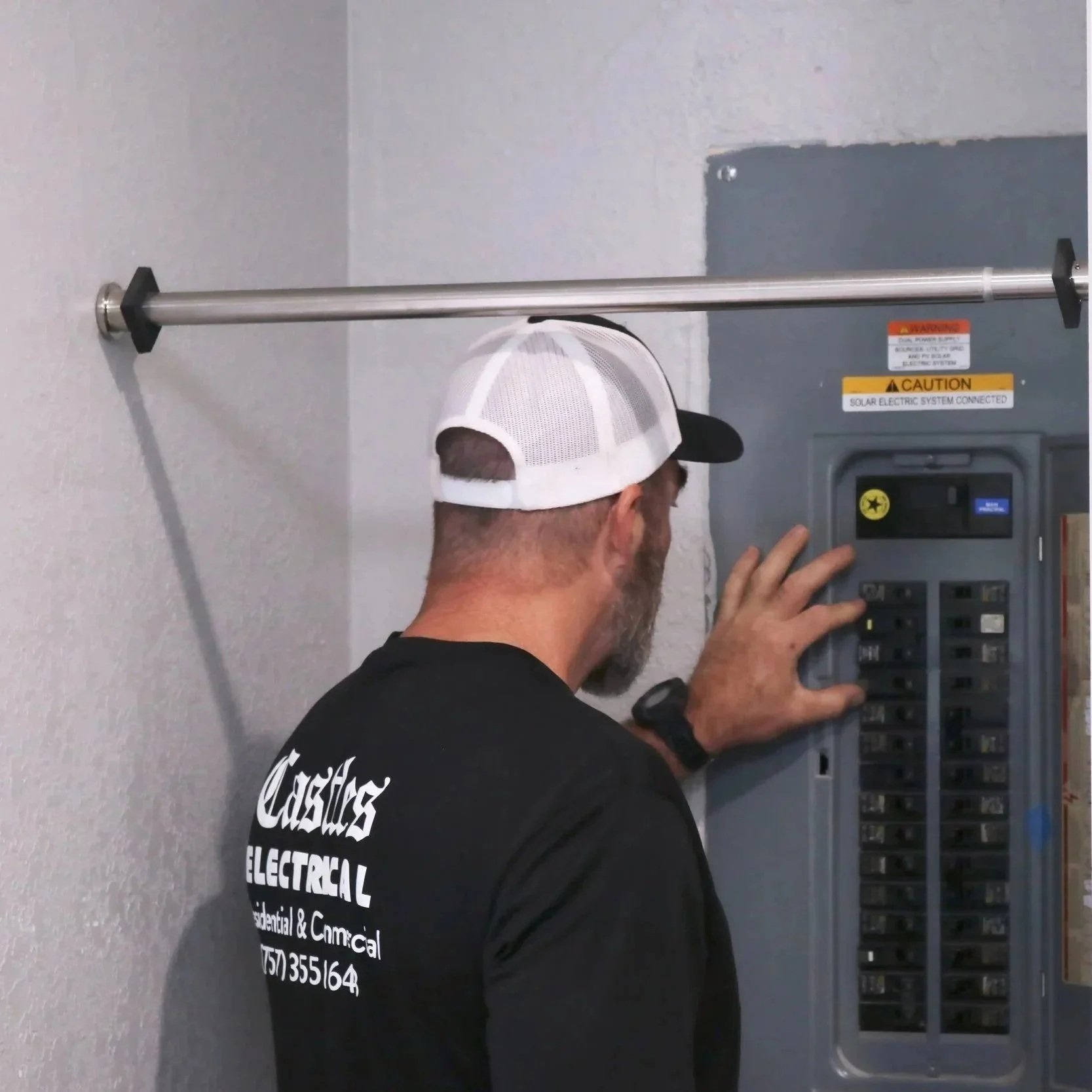
A hot circuit breaker is a major fire hazard. Virginia Beach homeowners should check their electrical panels for signs of overheating.
Why A Warm Breaker Panel Is Never Normal
Homeowners in Virginia Beach, Virginia, often notice subtle changes around their electrical panel long before a serious problem shows itself. A breaker that feels warm to the touch frequently gets brushed off as normal operation, especially during summer months when air conditioners work harder, and overall electrical demand rises. Heat, however, is not a standard byproduct of a healthy breaker. Circuit breakers are designed to interrupt power when electrical flow exceeds safe limits, not to radiate heat during everyday use. When warmth shows up on the breaker handle or panel face, internal resistance is already building somewhere in the system.
In real homes, that resistance often develops gradually due to loose connections, aging breaker components, or wiring that no longer fits modern electrical loads. Houses throughout Virginia Beach that were built decades ago were not designed for today’s appliance density, multiple refrigerators, EV chargers, or home office equipment, as electricity struggles to move through undersized or compromised pathways, and heat forms at the weakest point. That weak point is often the breaker itself. Ignoring that warmth allows damage to continue inside the panel, sometimes silently, until insulation degrades or arcing begins behind the cover, where homeowners cannot see it.
How Electrical Load Creates Dangerous Heat
Every electrical system balances load and capacity, even when everything appears to work normally. Problems arise when circuits operate near their limits for extended periods of time. Breakers that feel hot often protect circuits feeding large appliances, HVAC systems, or outlets that serve multiple rooms. In Virginia Beach homes, summer humidity adds another layer of strain, as air conditioning systems cycle longer and pull higher amperage. Heat buildup inside the panel increases when breakers operate near their maximum rating day after day.
Over time, sustained load causes metal components inside breakers to expand and contract repeatedly. Those small movements loosen terminal screws and internal contacts. As contact surfaces degrade, electrical flow becomes uneven, increasing resistance and generating more heat. Homeowners sometimes notice lights dimming slightly when appliances start or hear faint buzzing near the panel, both early indicators of load imbalance. Without correction, heat accumulation worsens, and the breaker may fail to trip when needed, allowing wires downstream to overheat instead. At that stage, the risk shifts from nuisance issues to real fire potential inside walls and ceilings.
Loose Connections And Hidden Panel Damage
Loose electrical connections represent one of the most common causes of hot breakers, especially in coastal environments like Virginia Beach, Virginia. Salt air, humidity, and temperature swings accelerate corrosion inside electrical panels. Corrosion increases resistance at connection points, forcing electricity to push harder through compromised surfaces. Heat becomes the byproduct of that struggle. Homeowners rarely see corrosion without removing the panel cover, so early warning signs often go unnoticed.
Inside many panels, especially older ones, wire insulation near breaker terminals darkens or becomes brittle from repeated heating cycles. Breakers themselves may show discoloration or warped plastic, though these signs remain hidden until inspection. Even newer homes can develop loose connections if breakers were improperly torqued during installation. Electrical vibration from appliances starting and stopping slowly loosens terminals over time. Heat builds quietly until one high-demand moment triggers failure. Professional inspections often reveal damage far beyond the single warm breaker, including heat transfer into the bus bar where multiple breakers connect, increasing system-wide risk.
Why Breakers Sometimes Feel Hot Without Tripping
Homeowners often assume a breaker will shut off power before conditions become dangerous. Reality does not always cooperate. Breakers respond to current overloads, not temperature alone. A breaker can grow dangerously hot while still carrying current within its rated amperage. Internal wear, corrosion, or manufacturing defects may prevent proper response under thermal stress. In those cases, the breaker continues passing power while heat damages internal components further.
In Virginia Beach homes with older electrical panels, certain breaker models are especially prone to delayed or failed tripping. Even modern breakers can struggle when exposed to sustained moderate overloads rather than short spikes. Electrical demand spreads across multiple devices rather than one obvious culprit, making problems harder to detect. Homeowners may notice a warm breaker only by accident, often while resetting another circuit. That warmth indicates the breaker is no longer performing its protective role reliably. Continued operation under those conditions increases the chance of insulation failure, arc faults, or ignition within the panel enclosure itself.
Environmental Factors Unique To Coastal Homes
Virginia Beach’s coastal climate plays a quiet but powerful role in electrical system wear. High humidity levels infiltrate panels through conduit openings and wall cavities. Moisture interacts with metal components, promoting oxidation and reducing conductivity at contact points. Breakers that might remain stable in drier climates deteriorate faster in coastal homes. Heat generation increases as electrical resistance rises, even when usage patterns remain unchanged.
Salt carried by ocean air compounds the issue by accelerating corrosion, particularly in outdoor meter bases and service entrance connections feeding the main panel. Problems originating at the service connection often manifest downstream as warm breakers inside the home. Homeowners may replace breakers repeatedly without addressing upstream damage. Electrical panels located in garages face additional stress from temperature swings and airborne contaminants. Over time, environmental exposure shortens component lifespan and increases fire risk, making regular professional evaluations especially important in Virginia Beach, Virginia.
Aging Panels And Outdated Breaker Technology
Many Virginia Beach, Virginia homes still rely on electrical panels installed decades ago, long before modern safety standards and appliance loads came into play. Aging panels often contain breaker designs that lack today’s thermal sensitivity and arc detection capabilities. Over time, internal springs weaken, contact surfaces pit, and calibration drifts. A breaker may still pass power, but no longer respond correctly to abnormal heat buildup. Homeowners often assume a breaker that has not tripped remains functional, yet aging technology quietly undermines that assumption.
Older panels also struggle to dissipate heat efficiently. Modern panels incorporate improved materials and spacing that help manage thermal stress across multiple circuits. Legacy panels trap heat more easily, especially when additional circuits have been added over the years. Improper breaker substitutions further complicate matters, as mismatched breakers may not seat correctly on the bus bar. Poor contact at that interface creates resistance, producing heat that spreads beyond the individual breaker. Over time, bus bar damage can affect adjacent breakers, multiplying fire risk across the entire panel rather than isolating it to a single circuit.
Shared Circuits And Overloaded Branch Wiring
Hot breakers often trace back to overloaded branch circuits rather than obvious appliance failures. In many homes, especially those remodeled or expanded without full electrical upgrades, multiple rooms share a single circuit. Kitchen outlets, lighting, and added convenience receptacles sometimes feed from the same breaker. When homeowners plug in space heaters, countertop appliances, or entertainment equipment simultaneously, the combined load pushes the circuit near its limits for extended periods.
Electrical heat develops not only at the breaker but along the entire wire run. Insulation inside walls gradually degrades under sustained warmth, even if no immediate symptoms appear. Breakers respond slowly to these conditions because the overload spreads evenly rather than spiking. Homeowners in Virginia Beach frequently experience these issues during seasonal changes when heating or cooling demands overlap with everyday usage. Warm breakers become the first visible sign of a broader wiring problem that, left unresolved, compromises safety throughout the home.
The Role Of Faulty Appliances And Equipment
Sometimes the source of breaker heat originates far from the panel. Faulty appliances draw inconsistent current due to internal wear, damaged cords, or failing motors. Refrigerators, pool pumps, and HVAC components commonly cause hidden electrical stress. As the current fluctuates, breakers experience repeated micro loads that generate heat without triggering immediate shutdown. Homeowners may replace the breaker only to see the problem return because the underlying appliance fault remains.
In Virginia Beach homes, salt air accelerates wear on outdoor equipment like pool systems and heat pumps. Electrical components corrode, increasing resistance within the appliance itself. That resistance reflects back through the circuit, heating the breaker over time. Plug-in devices with damaged cords also contribute, especially when used daily. Without proper diagnosis, homeowners may misinterpret symptoms and overlook the real source of the heat. Comprehensive electrical evaluations identify these indirect contributors before damage spreads to wiring and panel components.
Why Ignoring Heat Leads To Fire Risk
Electrical fires rarely start with dramatic warning signs. They develop quietly as insulation weakens, connections loosen further, and heat builds within enclosed spaces. A hot breaker signals ongoing stress that compounds over time. As temperatures rise, plastic components inside breakers soften, reducing their ability to interrupt current during faults. Wires feeding the circuit may exceed safe operating temperatures without visible signs until insulation fails.
Once insulation breaks down, arcing becomes more likely. Electrical arcs generate extreme heat capable of igniting surrounding materials within walls or panel enclosures. In Virginia Beach, homes with wood framing and older insulation face heightened risk. Fire investigations frequently trace ignition points back to overloaded or deteriorated electrical systems that showed early warning signs like warm breakers. Addressing heat early interrupts that progression, reducing long-term damage and preventing catastrophic outcomes.
Professional Inspection And Corrective Action
Diagnosing a hot breaker requires more than replacing a single component. Licensed electricians evaluate load distribution, breaker condition, wiring integrity, and environmental factors affecting the panel. Thermal imaging often reveals hidden heat patterns across breakers, bus bars, and conductors that standard visual inspections miss. In Virginia Beach, professionals also assess corrosion levels and moisture intrusion that influence system performance.
Corrective action may involve tightening connections, redistributing loads, replacing outdated breakers, or upgrading the panel entirely. In some cases, dedicated circuits for high-demand appliances relieve stress across the system. Addressing upstream service issues prevents recurring problems that surface at the breaker level. Professional work restores proper electrical flow, reducing resistance and stabilizing temperatures throughout the system rather than treating symptoms in isolation.
FAQs
A breaker can feel hot due to internal wear, loose connections, or corrosion rather than active appliance use. Residual heat may linger from earlier load cycles, and resistance at contact points continues generating warmth even at low current levels. Professional inspection identifies whether the heat stems from internal breaker failure or upstream wiring issues.
A warm breaker signals abnormal conditions but does not always require an emergency shutdown. Persistent heat, burning smells, buzzing sounds, or discoloration elevate the situation to urgent status. Turning off the affected circuit and scheduling prompt evaluation reduces fire risk while maintaining safety.
Breaker replacement sometimes resolves heat issues, but underlying causes often remain. Loose wiring, overloaded circuits, or faulty appliances may continue generating heat even with a new breaker installed. Comprehensive diagnosis prevents repeat failures and broader system damage.
High humidity and salt exposure accelerate corrosion inside panels and connections. Corrosion increases resistance, producing heat under normal electrical flow. Coastal homes like those in Virginia Beach experience faster electrical component degradation, making routine inspections especially important.
Homes in coastal environments benefit from professional electrical inspections every three to five years, or sooner if warning signs appear. Older homes or properties with heavy electrical usage may require more frequent evaluations to maintain safety and reliability.