
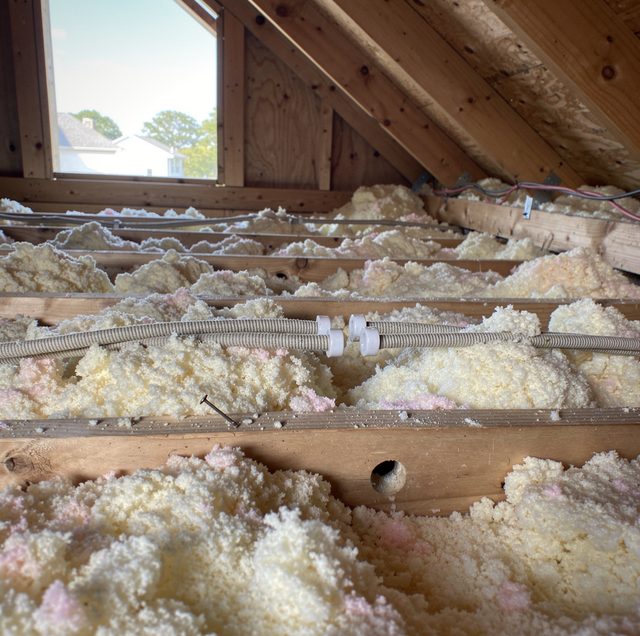
Knob-and-tube wiring was used in houses from roughly the 1880s to the 1940s, and the idea behind it was sound for its time. Whether it has to come out before you move in turns on what has happened to it since, not on its age alone: insulation blown over the runs, circuits tapped by owners who came later, rubber jacketing that has gone brittle, and loads nobody planned for when it was installed. The table below sorts the conditions an older house can present into what each one means and what to do next.
| Condition | What it means | What to do |
|---|---|---|
| Original wiring intact and unmodified | The conductors still hang in open air on their porcelain supports, with no ground and circuit sizes planned for lights and a few plug-in items | Keep loads light until an electrician evaluates it, then plan replacement on your own schedule |
| Insulation blown in over the runs | The open air the wire relied on for cooling is gone, so heat stays at the conductor | Put these circuits first in line and add no more insulation until they are dealt with |
| Circuits tapped or spliced by later owners | Connections of unknown quality, some possibly outside any box, feeding loads the old wire was not sized for | Have each modified circuit traced back to its source and schedule it early |
| Brittle or cracked insulation at fixtures | Years of lamp heat have aged the rubber where the wire enters the fixture, leaving copper close to exposed | Leave the fixture alone and include that circuit in the first round of work |
| Knob-and-tube feeding wet areas | Kitchens, baths, laundry, and exterior outlets run on two wires with no fault path to ground beside plumbing and damp floors | Replace these with grounded circuits and shock protection before the rooms see daily use |
| Mixed with newer grounded circuits | Some rooms are grounded, and some are not, and old and new conductors may meet in the same box or cavity | Ask for a circuit map so you know which outlets sit on which system |
How Knob-and-Tube Carries Current Without a Ground
The system runs the two conductors of each circuit separately. The hot wire follows one path, and the neutral follows another, several inches apart, held off the framing by porcelain knobs nailed to joists and studs. Where a wire passes through a joist or stud, it runs inside a porcelain tube so the wood never touches it. A flexible woven sleeve called loom covers the wires where they enter a switch, outlet, or fixture.
Each conductor wears a layer of rubber under a cloth braid. That rubber was never meant to hold heat in check on its own. The spacing did that job: a single wire suspended in the open air of a wall or ceiling cavity sheds heat in every direction, and the current each circuit was allowed to carry assumed that free air around it.
Splices were made along the run instead of inside a box. An installer soldered the joint and wrapped it in rubber and friction tape, then left it hanging between knobs.
What the system never had was a third conductor. A modern cable carries a bare or green ground wire that provides a low-resistance path for fault current back to the panel if a hot wire touches a metal fixture body or appliance frame. On a two-wire circuit, that metal can sit energized with nothing to clear the fault. The wiring can still carry current without trouble; what it cannot do is carry a fault on a metal fixture or appliance frame back to the panel.
Why Insulation Packed Around It Changes That
When cellulose or fiberglass is blown into an attic floor or a wall cavity, it fills the space around each conductor and blocks the path heat used to follow. Warmth that once drifted into the cavity now stays against the rubber jacket, and aged rubber that has run warm for years breaks down and cracks.
Two houses of the same age can land on opposite sides of this line. In one, the attic above the old runs was never insulated, or the insulation stops short of the wiring, leaving the conductors exposed to the conditions they were designed for. In the other, an energy upgrade years ago buried the runs, and nobody checked what was underneath. The first house can wait for a planned replacement. The second has circuits running outside its design, which changes the timeline before anyone moves in.
This also matters if you plan to insulate after you buy. Topping up a thin attic is a natural first project in an older house, and it can turn a stable knob-and-tube run into an overheating one.
Do not let an insulation crew blow cellulose or fiberglass over live knob-and-tube wiring. Buried conductors lose the air that cools them, and heat builds out of sight. A licensed electrician evaluates those runs before any insulation goes in.
Splices and Added Loads From Later Owners
Untouched knob-and-tube is a known quantity: one installer planned the circuits and made every connection the same way. The risk climbs with each change made since.
Over several owners, a house accumulates additions: an extra outlet, a ceiling fan where a pull-chain light once hung, a run extended into a finished attic. Each of those taps into conductors that were never meant to be opened after the walls closed. Newer cable can end up spliced onto old copper in an attic or wall cavity with no box around the joint, and a connection made without a box has nothing to contain heat or sparks if it loosens.
Because the hot and neutral follow separate paths, an addition can also pick up a hot from one circuit and a neutral from another. That neutral then carries current from a circuit whose fuse or breaker does not see it, and it can run above its rating with nothing set to open.
Load is the other half. A circuit laid out for a few bulbs and a radio now feeds a window air conditioner, a space heater, or a microwave. The wire does not change, but the heat it produces rises with the current through it, and on a circuit with a buried run or a weak splice, that heat collects at the worst point. An oversized fuse in an old fuse box removes the last check on that current, so fuse sizes are part of any evaluation.
What an Electrical Inspection Looks At
A general home inspection is visual: it can note knob-and-tube where it shows, but it is not set up to trace circuits, confirm which runs are still energized, or measure how much of the house depends on them. An electrician's evaluation answers those questions.
The evaluation works through the conditions in the table: whether the runs are active or were disconnected when newer wiring went in, whether insulation covers them, where splices and taps sit, the state of the rubber at fixtures and where wires enter boxes, which circuits feed the kitchen, baths, laundry and exterior, and whether fuse or breaker sizes match the wire behind them.
It also looks past the knob-and-tube itself, because a house old enough to have it can hold more than one dated system at once. An addition built decades later may have been wired in aluminum branch circuits, which raise their own connection concerns and need their own review. The panel may be an original fuse box or a breaker panel from a line now treated as obsolete, which shapes whether new grounded circuits can be added to it. A house built after these systems left use has none of them to find, so its evaluation stays narrower. An older house with fresh cover plates and three-prong outlets can still hide original wiring behind them, so the plates tell you nothing about the walls.
Schedule the electrician inside your purchase contract's inspection period and ask for a written list of every circuit still on knob-and-tube, with its condition. That list gives you the replacement order and something specific to bring to your insurer.
Full Rewire or Partial Replacement
A full rewire replaces every circuit in the house with grounded cable and disconnects the old system entirely. It is one disruption with one end state: no two-wire circuits left and every outlet grounded. It makes sense when the bulk of the circuits fall into the first three groups below, when walls are being opened for a renovation anyway, or when the panel is being replaced, and the new circuits need somewhere to go.
A partial replacement handles the circuits that carry the risk and leaves evaluated, unmodified runs in service for now. It suits a house where the old wiring is limited to a few rooms, or where the remaining runs are intact and uninsulated. The tradeoff is a house that stays mixed for a while, with a circuit map to keep.
When the work is phased, the order follows the conditions:
- Runs buried under insulation and runs with brittle or cracked rubber, since those are already outside their design.
- Circuits serving wet areas: the kitchen, baths, laundry, and any exterior outlets, where a missing ground sits beside water and grounded plumbing.
- Circuits with later splices or taps, and any that feed heavy plug-in loads such as window units or space heaters.
- The remaining unmodified runs in open air, which can be scheduled last.
Every new grounded circuit requires a slot and a breaker, so a fuse box or a crowded panel can slow the job down.
Living in the House During a Rewire
Rewiring an older house is a job of routing. An electrician runs new cable from the attic down into wall cavities and from the basement or crawlspace up, opening small holes in plaster at outlets, switches, and framing crossings instead of stripping whole walls. The work goes room by room, with circuits shut off in sections during working hours.
Moving in first is possible, and it changes the job. The crew needs clear access along the walls, into closets and through the attic and crawlspace hatches. Furniture has to be moved, and each opening in the plaster releases fine dust. Circuits for the refrigerator, a medical device, or a home office need planning so they stay live or come back each evening.
An empty house removes those constraints: the crew can open every room on day one and leave plaster repair until every run is in. If the purchase timeline allows a short gap between closing and move-in, that window lets the rewire proceed without anyone living nearby.
Frequently Asked Questions
Look in an unfinished attic, basement, or crawlspace for white porcelain knobs on the joists and single cloth-covered wires running apart. Inside the living space, two-prong outlets throughout and ceramic screw-in fuse sockets at the panel are clues, though neither proves the wiring type.
A three-prong outlet on a two-wire circuit has nothing connected to its ground slot, so the plug looks grounded when it is not. A GFCI outlet can add shock protection on an ungrounded circuit, with a label stating that no equipment ground is present. An electrician handles that swap.
No. Once an electrician disconnects it at the panel and at each end, the old conductors carry no current and can stay in the cavities. Pulling them out would mean opening far more plaster for no electrical gain. An electrician may pull a section that sits in the way of new cable.
Not on this wiring. Because the hot and neutral ran separately, some installations placed the switch on the neutral rather than the hot. With that switch off, the fixture socket and its wires can stay energized. Fixture work on an older house belongs with an electrician.
Knob-and-tube conductors were copper coated with tin. The tin kept sulfur in the rubber insulation from corroding the copper underneath, and it gives the bare ends a silver-gray look. That color can be mistaken for aluminum, and an electrician can tell the two apart at a cut end or a stripped section.
Not on the original box. A ceiling fan puts moving weight and vibration on its mount, and it needs a box listed for fan support. The boxes of that era were built to hold a light fixture. Adding the fan also adds load to a circuit that may already be due for replacement.
Schedule a knob-and-tube wiring evaluation before closing — an electrician traces each circuit still on the old system and sets the order to replace it. Castles Electrical serves Virginia Beach, Chesapeake, and Norfolk. Call (757) 765-8222.