
Whole-House Surge Protector: Is It Worth Installing?
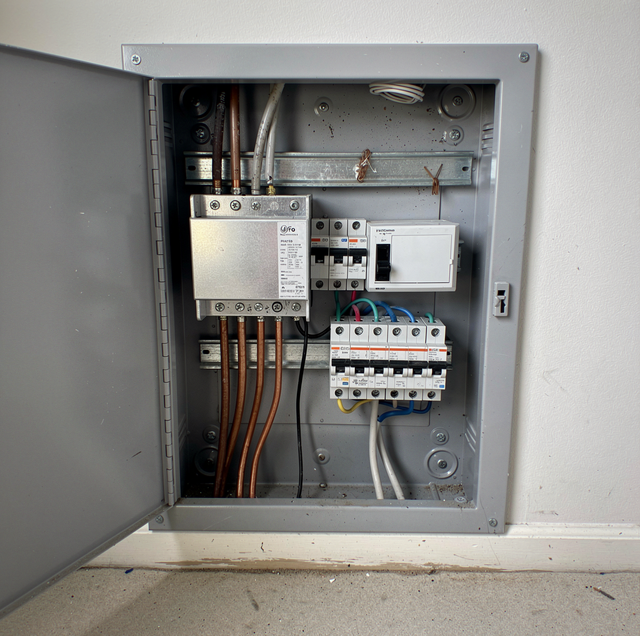
Quick Answer: A whole-house surge protector is a device wired into your electrical panel that clamps large voltage spikes and diverts the excess energy to ground before it reaches your circuits. It guards against surges from utility events, lightning, and the large motors inside your own home. It does not replace grounding or a battery backup, and it should be installed by a licensed electrician.
A surge is a fast, sharp jump in voltage on your home's wiring. Instead of the steady 120 volts your outlets normally hold, the line briefly spikes to hundreds or even thousands of volts, sometimes for less than a millisecond. That flash is long enough to degrade or destroy the sensitive components inside a TV, a computer, a smart thermostat, or a furnace's control board. A whole-house surge protector, more precisely called a surge protective device (SPD), sits at the electrical panel and catches that spike before it fans out across your circuits.
The way it does this is worth understanding, because it changes how you think about protecting a home full of electronics. The SPD monitors the voltage on the incoming lines and does nothing under normal conditions. When it senses a spike above a set threshold, it opens a low-resistance path and shunts the excess energy to ground in fractions of a second, then closes again once voltage settles. Your appliances see a much smaller bump instead of the full hit.
What Actually Causes a Surge
Most people picture a lightning strike, and lightning does produce the most violent surges. A nearby strike can couple thousands of volts onto power and phone lines even without a direct hit. But lightning is the rare case, not the common one.
The surges that reach your electronics most often start much closer to home, and they happen in every season.
Utility switching and grid events: The power company constantly balances load across its network. Capacitor banks switch on, transformers cycle, and crews restore power after an outage. Each of these can send a brief overvoltage down the line to your house. A downed line or a car striking a utility pole can do the same.
Internal surges from your own motors: This is the one most homeowners never think about. Every time a large motor stops, it dumps stored energy back onto your wiring. Your air conditioner compressor, refrigerator, well pump, garage door opener, and pool pump all do this each time they cycle off. These internal surges are smaller than a lightning event, but they happen dozens of times a day, all year long. The steady drip of these small spikes is what quietly ages the electronics in your home. Industry estimates commonly attribute most surge activity to these in-home sources rather than external ones.
Because the internal sources run year-round and the external ones cluster in stormy months, a surge protector earns its keep in January as much as in July.
How a Panel SPD Clamps and Diverts the Spike
Inside the device is a component, most often a metal oxide varistor, that behaves like a one-way valve for voltage. Below its rated threshold, it acts like an open switch and passes no current. Above that threshold, its resistance collapses almost instantly, and it becomes a conductor that routes the surge energy to the grounding system rather than through your circuits.
A pressure relief valve on a water heater stays shut through normal pressure, then opens the moment pressure climbs past a danger point and vents the excess safely. The SPD does the electrical version of that, thousands of times faster.
Panel devices come in two broad classes, and the difference matters.
Type 1 and Type 2: A Type 1 SPD is rated to connect on the line side of your main breaker, before the panel, and is built to handle the larger energy of external events. A Type 2 SPD connects on the load side, inside or beside the panel after the main breaker, and is the most common choice for whole-house protection. Both clamp and divert the same way; they differ in where they sit and how much energy they are rated to absorb. An electrician chooses based on your panel, your service, and whether the utility feed warrants line-side protection.
Why One Device Is Not the Whole Answer
A panel SPD is your first line, and it does the heavy lifting by knocking a large spike down to a much lower level. But it cannot bring every surge all the way down to zero, and some energy still gets past it. It also cannot stop a surge that originates downstream of the panel, such as one from a motor on the same circuit as your computer.
Layered protection is the recognized best practice. The panel device takes the big hit, and a quality point-of-use strip at your most sensitive equipment, a home office, a media center, cleans up the smaller residual spike right at the outlet. The two work as a team. A point-of-use strip alone is overwhelmed by a large event; a panel device alone lets small residuals through. Together they cover both ends.
Joules and Clamping Voltage in Plain Terms
Two numbers describe an SPD, and you can read them without any electrical background.
Joules measure how much surge energy the device can absorb over its life before it wears out. Think of it as the size of the tank. A higher joule rating means the device can soak up more energy, and more small hits, before it needs replacing.
Clamping voltage (sometimes listed as the voltage protection rating) is the level the device lets through while it is diverting. A lower clamping voltage means your electronics see a smaller leftover spike. It is the ceiling the SPD holds the line to during an event.
A good panel device pairs a high joule rating with a low let-through voltage. You do not need to memorize the figures, but knowing what they mean helps you compare devices your electrician suggests instead of guessing.
What a Surge Protector Does Not Do
Being clear about the limits keeps you from a false sense of security.
An SPD does not create or replace grounding. It works by dumping surge energy into your grounding system, so if that system is faulty or missing, the device has nowhere to send the energy and cannot protect anything. Proper grounding is the foundation the whole thing stands on.
An SPD is also not a battery backup. It does nothing for a blackout, a brownout, or a dip in voltage, and it will not keep your computer running for the seconds you need to save a file and shut down. That job belongs to an uninterruptible power supply, a UPS, which holds power steady and rides through short outages. A surge protector and a UPS solve different problems, and sensitive gear often benefits from both.
The Indicator Light and Knowing When It Is Spent
An SPD is a consumable. Each surge it absorbs uses up a little of its capacity, and one very large event can exhaust it in a single hit. When its protective components are used up, it stops protecting, often silently.
That is why nearly every quality unit carries a status indicator, usually a small light or window that glows green while the device is live and changes or goes dark when protection is gone. This light is the one part of the system a homeowner should glance at now and then. A device that has done its job and worn out looks identical to a working one from the outside; only the indicator tells the difference. If the light is off or shows a fault color, the unit needs replacing to restore protection.
A surge device that has worn out looks identical to a working one from the outside, so glance at its status indicator once or twice a year. A green light means it is still protecting; if the light is off or shows a fault color, the protective components are used up and the unit needs replacing.
Why This Is Licensed-Electrician Work
A panel-mounted SPD wires directly into your electrical panel, where the busbars carry lethal voltage even with individual breakers off. The device must be connected on the correct conductors, secured with short, straight leads for the fastest response, and tied into a verified grounding path to function at all. None of that is a homeowner task, and opening a live panel is dangerous.
The plug-in strips at your outlets are the homeowner-safe half of the system; you can place those yourself. The panel device is the part to leave to a licensed electrician, who will also confirm your grounding is sound before installing, since the SPD is useless without it. A professional install is what turns the device from a box on the wall into real protection.
Frequently Asked Questions
Many Type 2 units mount inside the panel and connect to a double-pole breaker, so they can occupy two slots. If your panel is full, an electrician can use a tandem breaker to free space or mount the SPD in a small enclosure beside the panel with its own disconnect. The mounting choice depends on your panel brand and available space, which the electrician checks during the site visit.
There is no fixed calendar life; longevity depends on how many surges it absorbs. A home on a clean, stable feed may see a device last well over a decade, while a home with frequent large events may exhaust one much sooner. Because wear is invisible from the outside, the indicator light is the real gauge, not the install date. Checking it once or twice a year is the simplest habit for staying protected.
No. An SPD passes normal current straight through without consuming meaningful power and does nothing to your usage. Its value is measured in the appliances and electronics it saves, not in kilowatt-hours. Any product marketing a surge device as an energy saver is conflating two unrelated things.
Yes, and it is common in homes with a detached garage, a workshop, or an addition fed by its own subpanel. Motors and equipment on a subpanel generate their own internal surges, so a dedicated Type 2 device there adds a layer of protection close to that gear. Each panel that feeds sensitive loads can carry its own SPD.
Some insurers view installed surge protection as a risk-reducing feature and may note it, though policies vary widely and it rarely changes a premium on its own. More to the point, an SPD reduces the odds of a claim by preventing damage. Reading your own policy language is the only way to know how your carrier treats it.
The strip under your desk is a point-of-use device rated for a small residual spike at one outlet; it has a modest joule capacity and protects only what is plugged into it. A panel SPD protects every circuit in the house at once and is rated for far larger energy. They are complementary, not interchangeable, which is why the layered approach uses both rather than choosing one.
Ask about panel-level surge protection during your next service call — protect every circuit in the house, not just the outlets you can see. Castles Electrical serves Virginia Beach, Chesapeake, and Norfolk. Call (757) 765-8222.
