
Fuse Box vs Breaker Panel: When Replacement Pays Off
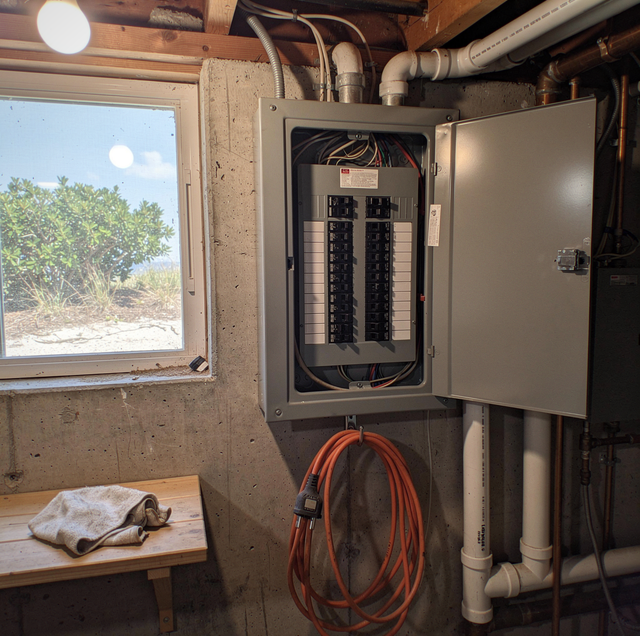
Quick Answer: A fuse and a breaker do the same job, cutting power when a circuit draws more current than its wire can safely carry. A fuse does it by melting a metal strip once, so it has to be thrown away and replaced. A breaker does it with a mechanism that trips and resets. Most homes still running on a fuse box are candidates for an upgrade, not because fuses are unsafe when correctly sized, but because the panel behind them rarely has the circuits, the 240-volt capacity, or the room a modern household needs.
If your home still has a fuse box, you are not automatically living with a hazard. A fuse that matches its circuit protects that circuit exactly as intended. The problem is rarely the fuse itself. It is everything around it: too few circuits for the way you actually use electricity, no easy path to add the higher-voltage circuits newer appliances want, and a design that quietly invites the one dangerous shortcut homeowners reach for when a fuse keeps blowing.
How A Fuse And A Breaker Actually Protect A Circuit
Every circuit in your home is a loop of wire sized to carry a set amount of current, measured in amps. Push more current through that wire than it is rated for, from too many devices on one circuit or a fault, and the wire heats up. Left unchecked, that heat is what starts fires inside walls. Both fuses and breakers exist to stop that heat before it builds.
A fuse is the simpler of the two. Inside its glass or ceramic body sits a thin metal element sized to carry the circuit's rated current and no more. When current climbs past that limit, the element heats and melts, physically breaking the loop. It works exactly once. After it blows, the fuse is spent and gets swapped for a new one of the same rating.
A breaker reaches the same result with a reusable mechanism. Most home breakers combine two triggers: a bimetallic strip that bends as it warms to catch slow overloads, and a magnetic element that snaps open almost instantly during a hard short. When either fires, the breaker trips to the off position. You reset it by flipping the handle back on. A fuse is a one-time sacrifice; a breaker is a switch that keeps its memory of how much is too much.
That reset ability is the day-to-day convenience people notice first. The bigger differences show up in what each system lets you do, and what it tempts you to do.
Why Older Fuse Panels Fall Short For A Modern Home
A fuse box is not dangerous by definition. A well-maintained one with correctly rated fuses can hold power safely. The trouble is that these panels were designed for the electrical demands of decades ago, and four gaps tend to open up over time.
Too few circuits: Older fuse panels commonly offered a small handful of circuits, often six to eight. A kitchen alone can now ask for that many between the refrigerator, microwave, dishwasher, and countertop outlets. When a whole house shares too few circuits, ordinary use trips into overload, and fuses blow not because anything is broken but because the panel was never sized for this much life running at once.
No practical 240-volt capacity: Large modern appliances, like an electric range, a clothes dryer, a heat pump, or an EV charger, run on 240-volt circuits. Many older fuse panels have no room and no design provision to add them. You end up wanting an appliance the panel cannot feed.
The oversized-fuse shortcut: This is the real hazard, and it is a human one, not a metal one. When a correctly sized fuse keeps blowing, the tempting fix is to screw in a higher-amp fuse so it stops. That defeats the entire point. The wire behind it is still only rated for the original current, so now the wire can overheat without anything cutting the power. Never install a fuse larger than a circuit is rated for. If a fuse of the correct rating keeps blowing, that is a signal the circuit is overloaded or faulted, and it needs a licensed electrician, not a bigger fuse.
Insurance and mortgage friction: Because that oversizing shortcut is so common and so hard to spot after the fact, many insurers and lenders treat fuse boxes as a raised-risk item. Some ask for an upgrade before binding a policy, some price around it, and a fuse panel can surface as a flag during a home sale inspection. The panel may be fine, but the paperwork around it often is not.
Signs Your Panel Is Undersized Or Failing
You do not need to open anything to notice these. Working inside a panel is licensed-electrician-only work, live with lethal voltage even when the main is off. What you can do is watch for the outward signs and call a professional to inspect:
• Fuses blow, or breakers trip, on a routine schedule rather than during a genuine fault.
• Lights dim or flicker when a large appliance, the AC, or a microwave kicks on.
• You rely on power strips and extension cords because wall outlets are scarce.
• The panel, a fuse, or an outlet feels warm, smells of hot plastic, or shows scorch marks.
• You want to add a major 240-volt appliance, and there is no open slot to feed it.
• A buzzing or crackling sound comes from the panel area.
A warm panel, a burning smell, or scorching is not a wait-and-see item. Stop adding load and get it looked at promptly.
Reading these signs is a bit like watching the temperature gauge in a car. The gauge climbing into the red does not tell you which part is at fault, but it tells you to stop and have someone qualified look before real damage happens. The signs above are your household's temperature gauge for its electrical system.
What A Panel Upgrade Involves At A High Level
Replacing a fuse box with a modern breaker panel is a defined project, and knowing its shape helps you judge whether it is worth it. At a high level, a licensed electrician assesses the home's total demand, coordinates with the utility to disconnect and later reconnect service safely, removes the old panel, and installs a new breaker panel sized for the home with room to grow. The service capacity is often increased at the same time so the home is not right back at its limit.
The work touches the point where the utility's power enters your home, which is why it is licensed, permitted, and inspected rather than a homeowner task. You should expect a power interruption during the swap and a scheduled inspection afterward. None of it is something to attempt yourself; the danger is not theoretical.
When Replacement Is Actually Worth It
Not every fuse box needs to go tomorrow. Replacement earns its place when the panel is holding your home back or raising real risk. Strong cases include:
• You are renovating, adding a room, or installing a 240-volt appliance the panel cannot feed.
• Fuses blow often enough that someone in the house is tempted to oversize them.
• An insurer or lender has flagged the fuse box, or you are preparing to sell.
• The panel shows heat, scorching, or corrosion, a sign that moisture or corrosive air has been reaching the equipment.
• You simply want the everyday convenience and added circuit capacity a modern panel gives.
A fuse box that is correctly fused, cool, uncorroded, and comfortably serving a modest load is not an emergency. But the moment your electrical needs outgrow it, or the moment anyone reaches for a bigger fuse, the calculus changes, and an upgrade becomes the safer and more practical path.
Frequently Asked Questions
No, and the differences matter for safety. Older panels use two main types: plug fuses that screw in like a light bulb for standard circuits, and cartridge fuses, cylindrical units that pull out and typically handle the higher-current main and 240-volt circuits. Standard screw-in plug fuses share the same thread, so a 30-amp fuse can be wrongly installed where a 15-amp belongs. Tamper-resistant "S-type" fuses use a rejecting adapter locked to one amp rating to block that mistake. Cartridge fuses come in their own distinct sizes and are not interchangeable across ratings.
A modern breaker panel typically has a service life in the range of a few decades before it is worth evaluating for replacement, though corrosion, moisture, and heat shorten that. Individual breakers can also weaken with age and repeated tripping, becoming slower to respond or nuisance-tripping, which you can't see from the handle. An electrician can test whether a breaker still trips within spec, a check worth doing on an older panel even when nothing has obviously failed.
No. Neither a fuse nor a breaker consumes any meaningful power itself; both are simply protective devices in the path of the current. Swapping to a breaker panel will not change your energy bill on its own. What can change usage is what the upgrade enables, such as adding an electric appliance or an EV charger you could not run before. The panel is a gatekeeper, not a consumer.
Sometimes, and only a licensed electrician can tell you if it applies to your home. A subpanel is a smaller secondary panel fed from the main, used to add circuits for a garage, addition, or workshop. It can expand circuit count, but it cannot fix an undersized main service or a failing main panel, because it still draws from that same limited source. If the core service capacity is the bottleneck, a subpanel just relocates the shortage rather than solving it.
Yes, and it is a distinct issue from the panel type. Some homes wired in a certain era used aluminum branch wiring, which expands and contracts differently than copper and can loosen at connection points over time, creating heat at outlets and switches. Finding a fuse box and aluminum wiring together is common in older housing stock. A panel upgrade does not by itself correct aluminum wiring; the connections throughout the home need their own evaluation and, where needed, approved correction methods.
Arc-fault protection guards against the small, sputtering electrical arcs that can start fires inside damaged wiring or a loose connection, a hazard neither an ordinary fuse nor a basic breaker detects, since both react only to overcurrent. Modern panels can use arc-fault breakers that sense the electrical signature of an arc and cut power before it ignites anything. A traditional fuse box has no equivalent, so upgrading is one way homes gain this layer of protection that older panels were never built to provide.
Book a panel safety inspection — know whether your fuse box is fine or holding your home back. Castles Electrical serves Virginia Beach, Chesapeake, and Norfolk. Call (757) 765-8222.
