
Why Does My Breaker Keep Tripping in the Summer?
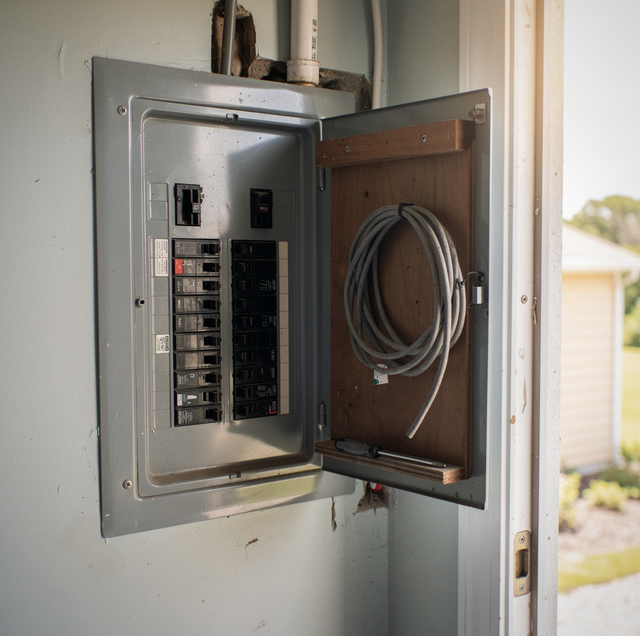
The air conditioner kicks on, the pool pump is already running, and somewhere in the panel a breaker snaps off mid-afternoon for the third time that week. Reset it and the lights come back, until the same thing happens tomorrow at almost the same time of day. That pattern, tripping that clusters around the hottest hours and eases once the sun goes down, is not a coincidence or a fluke in the breaker. It's the panel telling you something specific about how much a circuit is being asked to carry once summer heat gets added to the equation.
Why Summer Heat Raises the Load on a Circuit
A breaker's job is to open a circuit before the wire feeding it gets hot enough to be a fire risk. That threshold doesn't move with the seasons, but two things that feed into it do, and they both get worse in the summer.
The first is simple: summer adds more running appliances at once. Central air conditioning is the big one, cycling on for long stretches instead of the occasional short burst a furnace fan pulls in winter, and a compressor draws its heaviest current in the first fraction of a second it starts up. Add a window unit in a bedroom, a pool pump running most of the day, a couple of box fans, and a chest freezer working harder to hold its temperature against a hot garage, and a circuit that had comfortable room to spare in April can be running close to its limit by July.
The second factor is less obvious but just as real: heat itself changes how much margin a breaker and its wiring have left. A breaker is rated to carry its full labeled current at a specific ambient temperature, usually assuming a panel that isn't itself baking in a hot space. When the air around the panel, inside the wall cavity, or in an attic run climbs into the 90s and higher, the breaker and the wire both lose some of their ability to shed heat into the surrounding air. A circuit drawing the same amps it did in March can run measurably hotter in August, simply because there's less temperature difference available to push that heat away. A load that was borderline acceptable in cooler weather can cross into trip territory once ambient heat erodes that cushion.
Put those two things together, and summer becomes a stress test for circuits already running close to their limits for the rest of the year. The tripping isn't new damage happening in July; it's an existing margin problem that only shows up once heat closes the gap.
How Overload Protection Actually Works
It helps to know what a breaker is doing when it trips, because the mechanism is simpler than it sounds and it works exactly as designed in almost every summer-tripping case.
Inside a standard breaker sits a bimetal strip, two different metals bonded together that expand at different rates when heated. Current flowing through the breaker generates heat in that strip, and the more current, the faster it heats up. When the strip gets hot enough, it bends far enough to trip the mechanism and open the circuit. Pull less current and the strip heats slowly, giving a brief surge, like a compressor starting up, room to pass without tripping the breaker. Pull sustained current above the breaker's rating, and the strip heats fast enough to open the circuit within seconds to a few minutes, not instantly.
That delay is intentional. A circuit is allowed to run at its full rated current more or less indefinitely, and it can handle real surges above that for short bursts. What it can't do safely is carry more current than the wire is sized for over a sustained period, because that raises wire temperature enough to degrade insulation and create a fire risk. A breaker that trips when an AC unit, a pool pump, and a couple of smaller loads are all drawing current on the same 15- or 20-amp circuit is doing precisely the job it's built for: refusing to let a wire run hot enough to be dangerous. Treating that as a minor annoyance to reset past treats it as a safety mechanism rather than an inconvenience.
The Usual Culprits Behind Summer Tripping
A handful of situations account for most summer breaker calls, and they aren't equally common.
An air conditioning circuit sized too small for the equipment: Central AC and larger window or through-wall units draw a specific amperage specified by the manufacturer, and that circuit needs a breaker and wire gauge matched to it, with margin for the startup surge. A unit installed without confirming the existing circuit could handle it, or an older unit swapped for a newer, higher-capacity one on the same old wiring, is a common cause of a breaker tripping whenever the compressor cycles on a hot afternoon.
A breaker that has aged past its rated trip point: Breakers wear. The internal mechanism can degrade over years of thermal cycling, and a worn breaker may start tripping at a current below its printed rating, especially once heat is added to the mix. A 20-amp breaker that's carried loads near its limit for fifteen or twenty summers doesn't necessarily fail all at once; it can start tripping earlier each season as its internal tolerance shrinks, even though nothing about the wiring or the load has changed.
Too many devices sharing one circuit: This is the most common cause, and it isn't unique to summer, but it is when it surfaces. A bedroom circuit built decades ago to run a lamp and a clock radio now also powers a window AC unit, a fan, and a phone charger, and the combined draw exceeds the breaker's rating only when the AC is running. The circuit isn't broken. It's simply carrying more than it was ever designed for, and heat-driven appliances are usually the load that tips it over.
A degrading connection inside the panel or at an outlet: Loose or corroded connections increase resistance, which generates localized heat independent of the total current draw. With panel and wiring temperatures already running high in summer, a marginal connection that held up fine in cooler months can start contributing enough extra heat to trip a breaker that's otherwise carrying a reasonable load.
Telling an Overloaded Circuit From a Failing Breaker
These two problems produce similar symptoms, but they call for different fixes, and a few signs point toward one or the other.
An overloaded circuit tends to trip in a predictable pattern tied to what's plugged in and running. It happens when the AC, a fan, and something else all land on the same circuit at once; otherwise, it doesn't happen. Unplugging one device before resetting the breaker often stops the tripping entirely, at least until those devices run together again. The breaker itself, tested on a lighter circuit, holds without issue.
A failing breaker behaves differently. It trips at loads that shouldn't be anywhere near its rating, sometimes with nothing more than the AC running on a circuit that used to handle far more. It may trip at inconsistent points, tolerating a load one day and rejecting it the next, which suggests the mechanism itself has become unreliable rather than the load consistently exceeding a fixed threshold. A breaker that feels warm at the panel face, or whose switch feels loose or won't snap firmly into position when reset, points toward the hardware rather than the load.
A quick reference for sorting out which situation applies:
| Signal | Overloaded Circuit | Failing Breaker |
|---|---|---|
| Trip pattern | Consistent, tied to specific devices running together | Inconsistent, sometimes trips under light load |
| Removing a device before reset | Usually stops the tripping | Often doesn't help |
| Breaker feel | Normal, firm reset | May feel loose, warm, or resistant to reset |
| Same breaker on a lighter circuit | Holds fine | May still trip or fail to hold |
| History | New device or equipment added recently | Breaker is old relative to the panel's age |
Neither should be confirmed by guesswork. Both call for someone who can measure the actual current draw against the breaker's rating and test the breaker itself under load, rather than inferring the cause from symptoms at the panel door.
When Resetting Stops Being the Right Answer
Resetting a tripped breaker once in a while, especially the first hot week of the season when a new window unit gets plugged in, isn't automatically a red flag. But a pattern that repeats week after week is different from a one-time trip, and a few specific situations call for an electrician rather than another reset.
Tripping multiple times a week, especially without an obvious new device added to the circuit, means the margin problem described earlier has gotten past the point where it resolves on its own. A breaker that's warm, discolored, or shows any sign of scorching at the panel deserves attention regardless of how often it trips. A breaker that won't reset at all, or trips again within seconds of resetting, suggests either a short in the circuit or a breaker that's failed outright, not a simple overload. Any burning smell near the panel, however faint, is worth treating as an immediate call.
An electrician evaluating a summer-tripping problem typically checks the circuit's total amperage draw against the breaker's rating, the breaker's condition and age, the wire gauge feeding the circuit, and the connections at the panel and outlets for signs of heat damage or corrosion. That combination of checks is the only reliable way to determine whether the fix is redistributing load across circuits, replacing an aging breaker, upsizing a circuit for equipment it was never built to run, or addressing a connection that generates its own heat. A breaker that keeps tripping every summer is doing its job. The question worth answering is why it keeps having to.
Frequently Asked Questions
Each reset restores power without addressing why the circuit reached its limit, so the same conditions that caused the first trip remain for the next one.
Larger window units, especially ones rated above 12,000 BTU, often specify their own dedicated circuit for exactly this reason.
The same load that ran fine in spring can push a hot-attic circuit closer to its trip point in peak summer.
Most manufacturers specify a dedicated circuit for a pool pump precisely because it runs for extended periods and shouldn't be sharing capacity with other loads that could push the combined draw over the breaker's rating. Sharing that circuit with anything else is a common contributor to summer tripping.
A breaker has to match the wire gauge it protects; installing a higher-rated breaker on wire sized for a lower rating removes the protection the wire actually needs, allowing it to run hotter than it's built for without tripping. Any change to breaker size has to account for what the wire behind it can safely carry.
Schedule a summer circuit inspection — an electrician can check whether the tripping is caused by an overloaded circuit, an aging breaker, or a wiring issue, and recommend the right fix before the next heat wave. Castles Electrical serves Virginia Beach, Chesapeake, and Norfolk. Call (757) 765-8222.
