
Level 1 vs. Level 2 EV Charging: Which One Actually Fits Your House
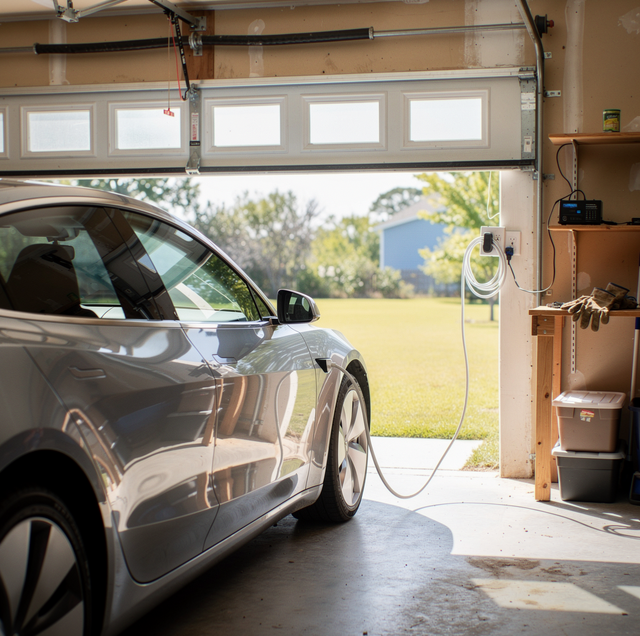
You bring the new EV home, plug the factory cord into the outlet in your garage, and go to bed feeling pretty good about the whole thing. The next morning you check the app and see the car added maybe thirty or forty miles overnight. That's fine if your commute is short and you never drive anywhere else. It is not fine if you had a longer errand day planned, or if two drivers in the house are trying to share one car and one outlet. That gap between what you expected and what actually happened is where most homeowners start asking the Level 1 versus Level 2 question, usually after they've already lived with the slower option for a few weeks.
Both setups will charge an electric vehicle. Neither is wrong, exactly. But they solve different problems, and the one you need depends less on brand preference and more on how your house is wired, how you drive, and what your electrical panel can actually support.
What Level 1 Charging Actually Means
Level 1 charging is the charger that comes in the trunk of almost every new EV. It plugs into a standard 120-volt household outlet, the same kind that powers a lamp or a phone charger, and it trickle-charges the battery at a slow, steady rate. Most Level 1 setups add somewhere in the range of 3 to 5 miles of range per hour, which sounds fine until you do the math on a battery that needs sixty or eighty miles replaced overnight.
The appeal is real: no installation, no electrician, no waiting. You unbox the cord, find an outlet, and you're charging. For someone who drives under twenty miles a day and always parks at home overnight, Level 1 can actually cover the need without much trouble. It's also a reasonable stopgap while you save up for a proper charger setup or wait for a panel evaluation to get scheduled.
The catch shows up the moment your daily mileage climbs, or the moment you need a full charge in a hurry after a long weekend trip. Level 1 charging is a bit like trying to fill a swimming pool with the hose you use for potted plants: it works, technically, and eventually you get there, but you'll be standing around a lot longer than you planned.
What Level 2 Charging Actually Means
Level 2 charging steps up to 240 volts, the same voltage used by a clothes dryer or an electric range. Instead of trickle-charging, it delivers charging speeds roughly 4 to 10 times faster than Level 1, depending on the circuit amperage and the charger itself. A Level 2 setup can typically add 20 to 40 miles of range per hour, which turns an overnight charge into a full battery rather than a partial one.
There are two common ways to wire a Level 2 charger into a home. The first uses a NEMA 14-50 outlet, the same style outlet often used for RV hookups, into which you plug a portable Level 2 charging unit. The second is a hardwired connection, where a licensed electrician runs a dedicated circuit directly to a wall-mounted charging unit with no plug involved at all. Both approaches require a 240-volt circuit; the difference is really about flexibility versus permanence. A NEMA 14-50 setup lets you unplug the charger and take it with you or swap units later. A hardwired unit tends to be more streamlined and is often the choice for a garage that's dedicated to one vehicle long-term.
Either way, Level 2 charging is not a plug-it-in-yourself project. Running a new 240-volt circuit, sizing the breaker correctly, and confirming the panel has room for the added load all call for a licensed electrician who can assess the full picture before any wire gets pulled.
Level 1 vs. Level 2: Side-By-Side Comparison
| Feature | Level 1 | Level 2 (NEMA 14-50) | Level 2 (Hardwired) |
|---|---|---|---|
| Voltage / Amperage | 120V, typically 12-16 amps | 240V, typically 40-50 amps | 240V, typically 40-60 amps |
| Charge Speed | ~3-5 miles of range per hour | ~20-30 miles of range per hour | ~25-40 miles of range per hour |
| Install Complexity | None; uses existing outlet | Dedicated circuit and outlet install | Dedicated circuit, direct wire to unit |
| Panel-Capacity Requirement | Minimal, existing service usually fine | Moderate; often needs available breaker space | Moderate to significant; may need panel upgrade |
| Typical Use Case | Short daily commutes, backup charging | Flexible garages, multi-EV households | Dedicated garage or driveway, single primary vehicle |
Why Your Panel Might Be the Real Question
The charger you choose is really only half the decision. The other half is whether your electrical panel has enough capacity to support it, and that question matters more in older homes than in newer construction. A panel that's already carrying a central air system, an electric water heater, and a kitchen full of appliances may be nearing its rated capacity before an EV charger ever enters the picture. Add a 50-amp circuit to a panel with little headroom, and you're not just risking tripped breakers; you're asking a system to do more than it was built to handle.
This often shows up in homes with older panel brands that are no longer manufactured or supported, panels sized decades ago for a much smaller electrical load, or houses that still have some original aluminum wiring in the mix. None of that means a Level 2 charger is off the table. It means a licensed electrician needs to look at the panel's rated capacity, the age and condition of the wiring, and the other loads already running through it before recommending whether you need a simple circuit addition or a panel upgrade first. Skipping that step and installing a high-amperage charger on a panel that can't support it is how houses end up with nuisance breaker trips at best and overheating connections at worst.
Outdoor and Garage Installs: Wiring That Has to Survive the Elements
A lot of EV charger installs land right at the edge of a garage or on an exterior wall facing the driveway, which means the wiring run often crosses from conditioned indoor space into an environment with real humidity swings and, for homes near the coast, salt-laden air. That combination accelerates corrosion on outdoor-rated conduit, connectors, and outlet boxes faster than most homeowners expect. A connection that looks solid on install day can develop corrosion inside a junction box within a couple of years if the wrong materials were used or if weatherproofing wasn't sealed correctly.
This is one more reason a Level 2 install, especially one routed to a garage or carport near an exterior wall, benefits from an electrician who treats the outdoor run as its own consideration rather than an afterthought. Proper weatherproof housings, corrosion-resistant hardware, and correctly sealed penetrations through exterior walls all matter far more for an outdoor-routed circuit than for an interior-only one.
When a Transfer Switch or Battery Backup Enters the Conversation
If you're installing a Level 2 charger anyway, it's worth a brief mention that storm-related outages can leave an EV sitting at whatever charge it had when the power went out, which is a different kind of inconvenience than a stalled gas car but still an inconvenience. Some homeowners use that moment to also ask about a transfer switch or battery backup setup so the home, and by extension the charger, has some resilience during an extended outage. That's a separate project with its own sizing and planning, not something to bolt onto an EV charger install as an afterthought, but it's a reasonable question to raise with your electrician while they're already evaluating your panel.
Making the Call: Which Charger Fits Your Home
If your daily driving is short, your car sits overnight at home, and you're not in a rush, Level 1 charging off an existing outlet can hold you over indefinitely. If you drive more than a short commute, share a vehicle with another driver, or just want the peace of mind of a full charge every morning regardless of what the day before looked like, Level 2 is the setup that actually matches how most households use a car.
The honest first step, either way, is a walk-through with a licensed electrician who can check your panel's available capacity, assess the condition of your existing wiring, and discuss whether a NEMA 14-50 outlet or a hardwired unit makes more sense for your garage layout. That assessment is what turns a guess into a plan, and it's the difference between a charger that quietly does its job for the next decade and one that becomes a recurring headache.
Frequently Asked Questions
In most cases, yes. If a licensed electrician confirms your panel has enough available capacity, adding a dedicated 240-volt circuit later is a separate, self-contained project that doesn't require touching your existing Level 1 outlet, so there's no real penalty to starting with Level 1 while you plan ahead.
Battery size varies quite a bit between models, and a vehicle with a larger battery pack takes proportionally longer to refill at any charging level, so a driver with a longer-range EV and higher daily mileage tends to notice the Level 1 versus Level 2 gap sooner than someone driving a smaller-battery vehicle on a short commute.
No. Because it's the same outlet style commonly used for RV hookups and some outdoor cooking equipment, a NEMA 14-50 installed for EV charging can double as a general-purpose 240-volt connection point for other equipment, which is part of why some homeowners prefer the plug-in option over a hardwired unit.
Recurring trips after a new charger circuit is installed almost always indicate a load or panel capacity issue that should have been caught during the initial assessment, and it's a sign to have the electrician who did the install come back and re-evaluate rather than simply resetting the breaker and continuing to use the circuit.
Yes. A longer run from panel to charger, common when the garage or parking area sits far from the main electrical panel, can require larger-gauge wire to avoid voltage drop over distance, which is one of the variables an electrician factors into the circuit design rather than something with a one-size answer.
A smart panel can track and, in some cases, manage how power is distributed across circuits in the home, which is useful if you're adding an EV charger alongside other high-draw equipment like a generator transfer switch, since it gives you visibility into how close the whole system is running to its rated limits.
Schedule a home charging assessment — have a licensed electrician evaluate your panel capacity and wiring before you commit to Level 1 or Level 2. Castles Electrical serves Virginia Beach, Chesapeake, and Norfolk. Call (757) 765-8222.
