
Can Your Panel Handle an EV Charger? Here’s How to Tell
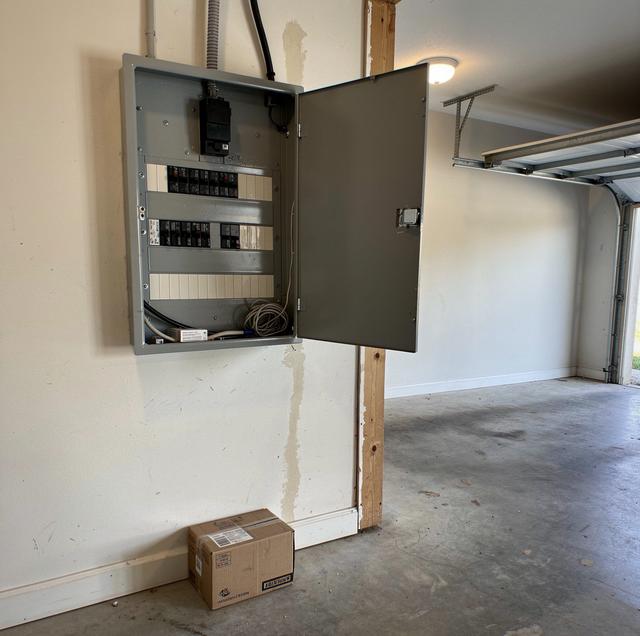
Your dryer kicks on, the AC compressor cycles, and somewhere in the garage a new 240-volt EV charger wants forty more amps than your panel has ever had to give up at one time. That's the moment when an EV charger installation stops being a shopping decision and becomes a math problem. The panel either has room for that load or it doesn't, and there are real ways to tell which one you're dealing with before any wiring goes in.
What Your Panel Actually Has to Carry
Every electrical panel has a total amperage rating stamped on the inside of the door, usually 100, 150, or 200 amps. That number is the ceiling for everything the panel delivers at once, not a suggestion. Central air conditioning, an electric water heater, an electric dryer, an electric range, and every outlet and light circuit in the house are already pulling from that same ceiling. A Level 2 EV charger typically needs its own dedicated 30- to 50-amp, 240-volt circuit, which is a larger single draw than almost anything else in a typical home except maybe a range or central AC.
Panel amperage: The number stamped on the main breaker or panel label, telling you the maximum total current the panel is built to handle across every circuit combined.
The gap between what a panel is rated for and what it's actually using at peak times determines whether a new 30- to 50-amp circuit will fit. A 100-amp panel serving a home with electric heat, an electric water heater, and an electric range may already be running close to its limit before an EV ever enters the picture. A 200-amp panel with gas heat and a gas water heater often has plenty of room to spare for the same charger.
How a Load Calculation Works in Plain Terms
A load calculation adds up the home's actual loads, square footage for general lighting, the small-appliance and laundry circuits, and the nameplate ratings on major appliances and heating and cooling equipment, applies the demand factors the code allows for things that never all run at once, and compares that total against the panel's rating. Continuous loads, meaning ones that run steady for three hours or more like EV charging, get sized as if they'll draw at that level the whole time, plus a margin so the breaker and wire aren't run at their absolute limit hour after hour. That margin is part of why a charger asking for 40 amps of continuous draw often ends up on a 50-amp breaker with matching wire rather than a 40-amp one.
When the total, including the new EV circuit, comes in under the panel's rating with a reasonable margin left, the existing panel can usually take the new circuit as is. When it doesn't, something has to change: the panel size, a load management device that limits charging when other big appliances are running, or moving some load off the main panel and onto a subpanel.
Level 1 vs. Level 2: Two Very Different Asks of Your Panel
Not every EV charger asks the same thing of a panel. Level 1 charging uses a standard 120-volt outlet, the same kind everything else in the house plugs into, and adds roughly 12 amps of draw. It's slow, often adding only a handful of miles of range per hour, but it rarely requires any panel work at all since it typically runs off an existing circuit. Level 2 charging runs on 240 volts, the same voltage as a dryer or range, and typically pulls 30 to 50 amps on a dedicated circuit. It charges several times faster than Level 1, but it's also the version that prompts the load calculation question.
NEMA 14-50 outlet vs. hardwired connection. Level 2 chargers connect to the panel one of two ways. A NEMA 14-50 outlet is a plug-in setup, the same style outlet often used for RVs, mounted near where the car parks, with the charger's cord plugging into it like a large appliance. A hardwired connection skips the outlet and wires the charger directly into its own circuit, similar to how a Tesla Wall Connector is commonly installed. Both draw the same amperage from the panel; the difference lies in the wall connection, not in the load the panel must support.
| Level 1 | Level 2 | |
|---|---|---|
| Voltage | 120V | 240V |
| Typical amperage | ~12A | 30-50A |
| Circuit type | Existing outlet | Dedicated circuit |
| Connection | Standard plug | NEMA 14-50 outlet or hardwired |
| Panel impact | Minimal to none | Often requires a load calculation |
| Charging speed | A few miles of range per hour | Full charge overnight or faster |
Signs Your Panel Is Already Maxed Out
Some panels show they're at their limit long before an EV charger ever enters the conversation.
Double-tapped breaker: Two wires crammed under a single breaker terminal designed for one, usually a sign the panel ran out of open slots and someone improvised instead of adding capacity the right way.
Other warning signs worth paying attention to:
- Breakers that trip under normal use, especially when the dryer, AC, and something in the kitchen all run at the same time.
- A panel that's completely full of breaker slots with no open spaces for a new circuit.
- A panel that feels warm near the cover, or shows scorch marks or a burning smell, both signs the internal connections are already under strain.
- Lights that dim noticeably when the AC compressor kicks on, suggesting the panel or its incoming service wire is working harder than it should.
When the Panel Itself Is the Real Problem
Sometimes the issue isn't whether there's room for one more circuit; it's that the panel shouldn't carry any new load at all. Panels made by Federal Pacific Electric (FPE) or Zinsco have a well-known history of breakers failing to trip when they should. Both brands stopped being manufactured decades ago, so replacement parts are scarce, and the panels themselves are well past any reasonable service life. Adding an EV circuit to one of these panels isn't really a wiring question; it's a replacement question, and that's true whether or not a car ever gets plugged in.
Older homes sometimes still have aluminum branch wiring or knob-and-tube wiring, both of which complicate the addition of a large new 240-volt load. Aluminum wiring expands and contracts differently than copper and can loosen at its connections over the years, which matters more once a circuit is asked to carry a steady 40-plus amp charging load for hours at a stretch. Humidity plays a role too. Corrosion on breaker contacts, lugs, and outdoor equipment builds up over the life of a panel, which is worth weighing when deciding if an aging panel is a good candidate for one more circuit or a better candidate for replacement.
What a Panel Check for EV Readiness Actually Involves
Figuring out whether a panel can take an EV charger starts with reading the amperage rating off the panel label, then adding up the home's actual loads: square footage, appliance nameplate ratings, and heating and cooling equipment, the same inputs a formal load calculation uses. From there, it's a matter of checking what's actually pulling power on a typical day, since a house with gas heat and a gas dryer has very different headroom than one running electric heat, an electric water heater, and an electric range off the same panel. If the numbers work, the next step is to confirm there's an open double-pole slot for the new 240-volt breaker and that the wire path from the panel to the charger location is workable. If the numbers don't work, the options move to panel replacement, a subpanel near the garage, or a load management device that keeps the charger from pulling full amperage while other big appliances are running.
Frequently Asked Questions
Not always, and the panel itself isn't always the limiting factor. The service conductors running from the meter to the panel, and the meter base they land in, carry their own amperage ratings, and either one can cap what the panel can deliver even when the panel's own rating checks out fine. A real answer means checking the conductors and meter base along with the panel, not just the number on the panel door.
It's possible in some homes, but it usually calls for either two dedicated circuits with enough combined headroom or a shared energy management device that limits both chargers so they never draw full amperage at the same time. Running two 30- to 50-amp circuits without that kind of coordination is one of the fastest ways to overload a panel that handled one charger just fine.
Both are safe when sized and installed correctly, but a plug connection carrying 40-plus amps for hours at a time has more points where a loose fit can build up heat over years of use than a hardwired connection does. That's part of why some electricians lean toward hardwiring a charger that gets used daily rather than occasionally.
In most areas, yes. Since the new circuit ties into the main panel and usually adds a new double-pole breaker, it typically gets reviewed as part of the standard electrical permit and inspection process for the work, the same as any other new circuit added to a panel.
A subpanel doesn't add capacity, only slots. It works when the service still has headroom, but the panel is physically full; it does nothing if the calculated load is already at the service rating.
A basic check, reading the panel label, counting breaker slots, and reviewing what's drawing power during peak times, can often be done in well under an hour. It takes longer if the electrician also needs to open the panel to inspect for double-tapped breakers, corrosion, or an outdated brand like FPE or Zinsco before giving a real answer.
A panel running a dryer and a range without trouble still needs the math run before a 30- to 50-amp charger circuit gets added, and a panel already showing warning signs needs attention long before an EV enters the picture. The load calculation, not a guess based on the panel's age or amperage rating, settles the question.
Schedule an EV charger load assessment — an electrician checks your panel's amperage rating, current load, and available circuit space before any wiring goes in, so you know exactly what your panel can support. Castles Electrical serves Virginia Beach, Chesapeake, and Norfolk. Call (757) 765-8222.
