
Signs Your Electrical Panel Is Overloaded and Needs an Upgrade
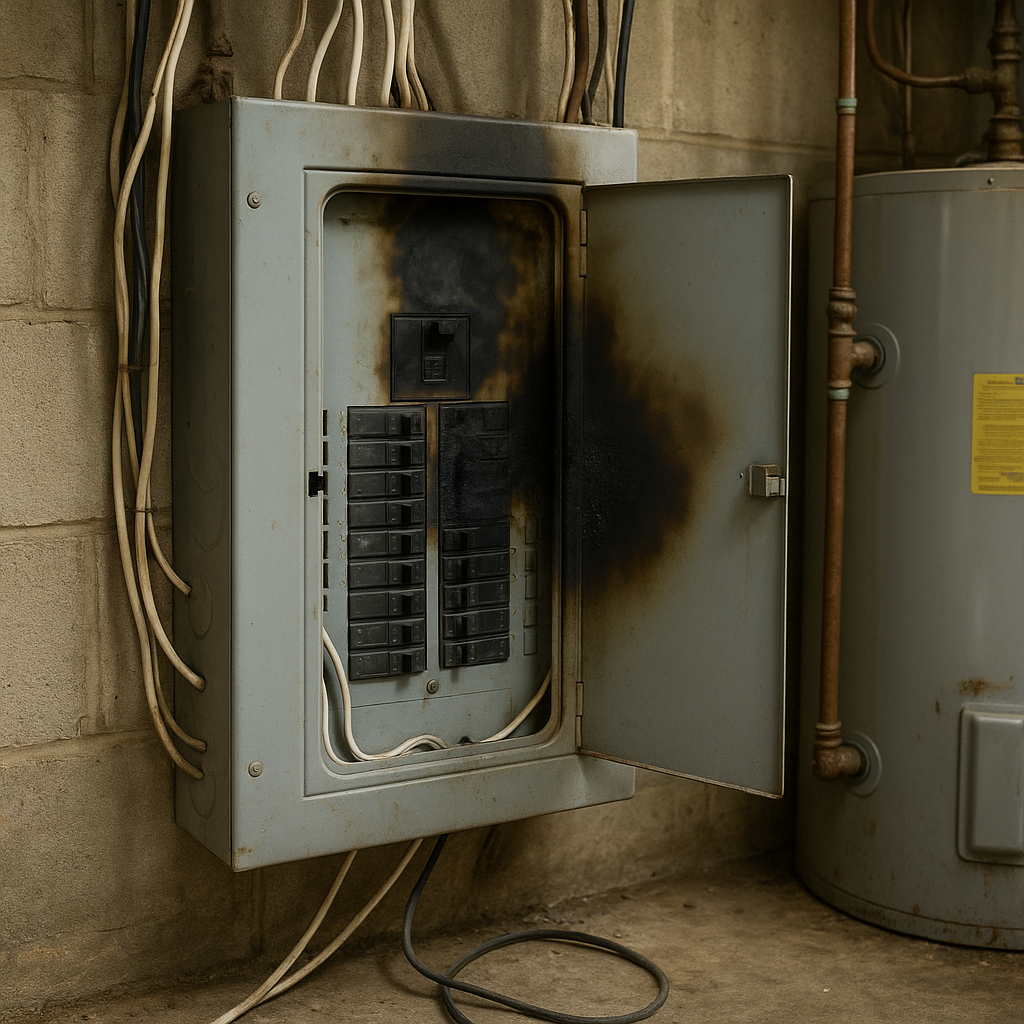
Quick Answer: Your electrical panel is likely overloaded when the main breaker trips repeatedly, lights dim across the whole house each time a big appliance starts, or the panel feels warm or smells hot. Those signs point to the overall service running out of capacity, not one bad circuit. Have a licensed electrician run a load calculation before adding any new large loads. A burning smell or scorch marks at the panel is an emergency, so call right away and do not open the panel yourself.
Your electrical panel is the point where the power coming in from the utility is divided and sent to every part of the house. One large wire feeds the panel, and from there the current splits across dozens of branch circuits, each protected by its own breaker. That arrangement works cleanly as long as the total demand stays inside two limits: the size of the service feeding the panel, and the capacity the panel itself was built to handle. A panel becomes overloaded when the demand you put on it outgrows one or both of those limits.
Think of the panel like the checkout lanes at a busy store. Each lane, or circuit, can move a certain number of shoppers, and the store has only so many lanes open. Add a few more customers to one lane, and that lane backs up. But add far more shoppers than the whole store can process, and it does not matter how the lanes are arranged, because the building itself is past its limit. An overloaded panel is the second problem, not the first, and telling the two apart is the key to knowing what you actually need.
What "Overloaded" Actually Means
Every home has a service rating, measured in amps: often 100, 150, or 200 amps on newer homes, and 60 or 100 amps in older ones. That number is the ceiling on how much current the utility connection and the panel are built to deliver at once. Your appliances, lighting, heating, cooling, and everything else draw against that ceiling. On an average day, you use a fraction of it. The trouble starts when the things you run at the same time, especially the heavy hitters like central air conditioning, an electric range, a heat pump, or an EV charger, push the combined demand toward or past what the service was sized for.
There is a difference worth holding onto here. A single circuit can be overloaded on its own, which is a local problem confined to that one branch. The whole service can also be maxed out, which is a house-wide problem. The signs below help separate the two, because the fix is different for each.
The Warning Signs of an Overloaded Panel
Breakers That Trip Again and Again- A breaker that trips is doing its job, cutting power before a wire overheats. Occasional trips on one circuit, say the kitchen breaker when the microwave and toaster run together, usually point to that circuit carrying too much or to a fault on it. The more serious signal is the main breaker tripping. The main protects the entire service, so when it opens, the message is that the sum of everything running exceeded what the whole panel can carry. That points at the service as a whole rather than any one room.
Lights That Dim or Flicker When Big Appliances Start- Watch what happens to your lights the moment the air conditioner compressor kicks on, or the well pump, or the dryer. A brief, slight dip can be normal. A noticeable, repeated dimming or flickering across many rooms at once is a sign that the service is straining to supply a large starting load on top of everything else it is already carrying. When the whole house reacts, the whole service is the suspect.
A Panel That Feels Warm, Hums, or Buzzes- A healthy panel cover is at room temperature and quiet. Warmth you can feel through the cover, a steady buzzing, or a humming sound means the current is heating something inside that it should not be. That heat comes from connections working harder than they were meant to.
A Burning Smell or Scorch Marks- The most urgent sign is any burning or hot-plastic smell near the panel, or visible browning, melting, or scorch marks on the cover or around a breaker. This is not something to schedule for next week. Stop using the affected circuits and call for help immediately.
No Open Slots and Double-Tapped Breakers- Open the panel door and look at the breaker layout, without touching anything inside. If every slot is filled, there is no room to safely add a circuit. A related red flag is a "double-tapped" breaker, where two wires are pushed under a single breaker terminal built for one. People do this when they run out of slots, and it is a strong hint that the panel is both full and often near its capacity.
Living on Extension Cords and Power Strips- If rooms depend on a web of extension cords and multi-outlet power strips to reach everything that needs plugging in, the house does not have enough circuits for how it is used. That is a wiring capacity shortfall that points back to the panel.
An Old, Small Service Feeding a Modern Home- A 60-amp or 100-amp service was often sized for a home without central air, without electric appliances across the board, and long before anyone charged a car in the garage. A fuse box, rather than breakers, is an even older setup. None of these is inherently unsafe, but a home that keeps tripping the main or has nowhere to add a new large load has usually outgrown the service it was originally rated for.
A Panel Brand With a Known History- Some older panel brands have a well-known reputation for breaker problems among electricians. If your panel carries one of those names, that alone is worth a professional look, separate from any capacity question.
Why an Overloaded Panel Is Worth Taking Seriously
The reason this matters comes down to heat. When a service or a connection carries more current than it should, the wiring and the terminations warm up. Loose or overworked connections concentrate that heat at a single point. Over time, insulation degrades, contacts char, and the risk of an electrical fire climbs. An overloaded panel also boxes you in practically: you cannot safely add the circuit for a new heat pump, hot tub, or car charger when there is neither room nor capacity to spare. The problem quietly compounds instead of resolving on its own.
What a Licensed Electrician Does About It
The first step a professional takes is a load calculation. Rather than guessing, the electrician calculates the home's actual electrical demand, accounting for large appliances and their operating characteristics, and compares that total to the service rating. That measured number is what tells you whether the service is truly maxed or whether the trouble is one overloaded circuit that can be corrected on its own.
From there, the solutions fall into a few paths. If the whole service is undersized for the home, the fix is a service upgrade, commonly to a 200-amp panel, which raises both capacity and slot count and involves the utility and a permit. If the service has enough capacity but simply ran out of slots, a subpanel can add room for more circuits fed from the existing service. And in some cases, load management, spacing out, or controlling when the biggest loads run, keeps demand under the ceiling without a full upgrade. Which path fits depends entirely on what the load calculation and a hands-on inspection turn up.
A Word on Safety Before You Look
You can safely read the brand name and check for warmth, smells, or sounds from outside the closed panel. That is as far as a homeowner should go. The busbars inside a panel remain energized even with the main breaker off because the utility feed is ahead of that main. There is no safe way to test breakers, tighten connections, or clear slots yourself. This is work for a licensed electrician, coordinated with the utility, and permitted where required. If you notice a burning smell or scorch marks, treat it as an emergency and call for help right away.
Frequently Asked Questions
A useful tell is when the main trips only as several big loads start together, the AC, plus the dryer, plus the oven, which says the service is bumping its ceiling. A branch breaker that trips on its own, with nothing unusual running elsewhere, points instead to that one circuit or a fault on it. So watch what else was on at the moment it opened: many heavy things at once means the whole service, one lonely circuit means a local problem you can fix on that branch.
A few breaker models are listed to accept two conductors at a single terminal, but most are rated for a single wire only. A double tap on a single-rated breaker is then both a code problem and a safety problem, one that an electrician corrects with a proper breaker or a subpanel rather than leaving two wires fighting for one lug. Seeing it at all is a practical sign that the panel ran out of slots and someone improvised instead of adding room the right way.
One common hidden heat source is aluminum branch wiring oxidizing where it lands at the breaker and neutral terminals, which loosens the connection and lets it heat up under load. In an aluminum-wired home, a warm panel is checked at those terminations specifically, since that is where the trouble tends to start. Warmth, a buzz, or a hot-plastic smell is an active fire risk rather than a nuisance, so stop loading those circuits and get a licensed electrician out promptly.
Not automatically. Plenty of homes run fine on 100 amps. The catch is that a 60-amp or 100-amp service was usually sized before central air conditioning, whole-house electric appliances, and EV charging were common. So the question is not the number on its own but how the house is used against it. A home that keeps tripping the main, or that has no room and no capacity to add a big new load, has usually outgrown what that older service was meant to deliver.
Sometimes, and it depends on why you are out of the room. A subpanel adds more circuit slots and is fed from your existing service, so it solves the problem of physically running out of places to land new circuits. What it does not do is add any total capacity, since it still draws from the same service ahead of it. If the main is tripping because the whole service is truly maxed, a subpanel just redistributes the same limited supply, and the service itself has to be upgraded.
The core tool is a load calculation that adds up the home's actual electrical demand and compares it to the service rating to show whether you are over the limit. Alongside that, the electrician inspects the panel for signs of trouble: heat at connections, double-tapped breakers, corrosion on the busbars, and full slots. Basing the diagnosis on measured demand and a hands-on inspection keeps the recommended fix grounded in the home's actual numbers rather than a guess.
Have your panel load-tested before the next breaker trips — get a clear read on whether an upgrade is worth it. Castles Electrical serves Virginia Beach, Chesapeake, and Norfolk. Call (757) 765-8222.